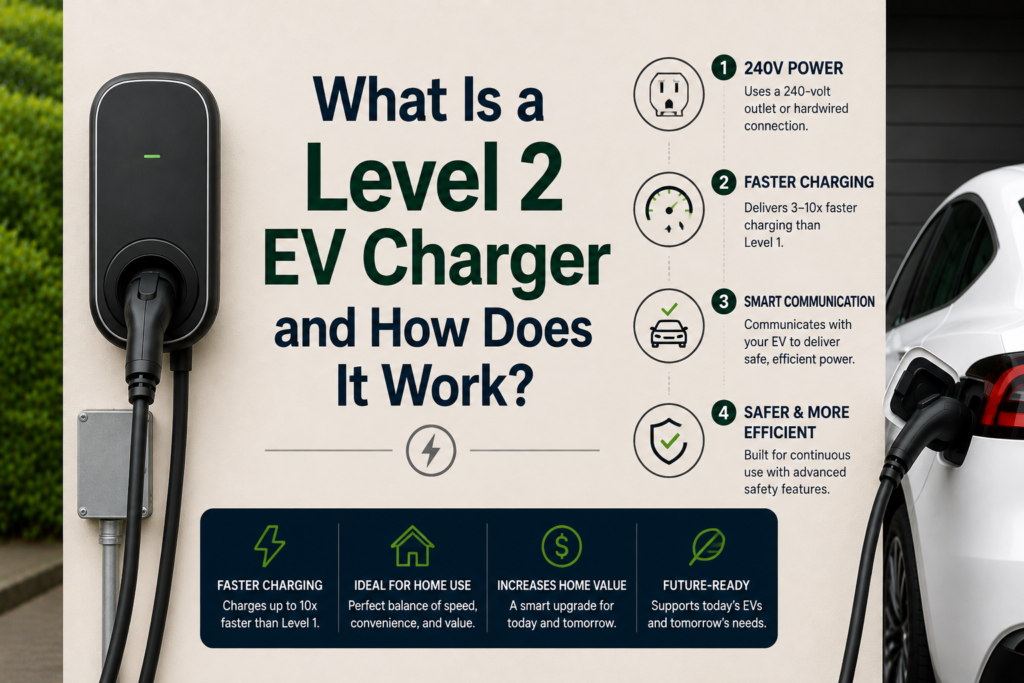
Every EV owner eventually faces the same question: is it worth upgrading from the charging cable that came in the trunk, or is a basic wall outlet good enough? The answer depends almost entirely on the difference between Level 1 and Level 2 charging. Here’s a full breakdown of how they compare, and how to decide which one actually fits your situation.
The Core Difference: Voltage
The fundamental difference between Level 1 and Level 2 charging comes down to one thing: voltage.
- Level 1 uses a standard 120-volt household outlet — the same type used for lamps, phone chargers, and small appliances.
- Level 2 uses a 240-volt circuit — the same voltage used by a clothes dryer, electric range, or water heater.
Everything else — charging speed, equipment cost, installation requirements — flows from that single difference in voltage.
Charging Speed Comparison
This is where the two options diverge the most in practice.
| Level 1 (120V) | Level 2 (240V) | |
|---|---|---|
| Typical range added per hour | 3 – 5 miles | 20 – 45+ miles |
| Time for a full charge (typical EV) | 20 – 40+ hours | 4 – 10 hours |
| Equipment needed | Cable that ships with the car | Dedicated wall charger or plug-in unit |
| Installation required | None (uses existing outlet) | Yes, typically a licensed electrician |
For context: if you drive a typical daily commute of 30–40 miles, Level 1 charging can often keep up — as long as you plug in every single night without exception. But if you drive more, own a larger-battery EV, or need to recover a significant charge quickly, Level 1 charging usually can’t keep pace with real-world usage.
Equipment and Installation Cost
- Level 1 requires no new equipment or installation in most cases — you use the portable cable included with your vehicle and an existing outdoor or garage outlet. Cost: effectively $0, assuming your existing outlet is in good condition and on its own circuit.
- Level 2 requires purchasing a charging unit (typically $300–$700) plus professional installation of a dedicated 240-volt circuit, which commonly runs $300–$1,500 depending on your home’s electrical panel and the distance from the panel to the parking spot.
We break down installation costs in much more detail in our dedicated guide on how much it costs to install a home EV charger.
Who Level 1 Charging Actually Works For
Level 1 isn’t obsolete — it’s simply built for lighter use cases:
- Drivers with a short daily commute (under ~30-40 miles round trip)
- Plug-in hybrid owners, whose smaller battery packs charge fully overnight even at 120V
- Renters or apartment dwellers who can’t install dedicated charging equipment
- Anyone using an EV as a secondary vehicle, driven only occasionally
If your daily driving needs are modest and you’re consistently able to plug in overnight, Level 1 can genuinely be “enough” — especially in the first months of EV ownership, before deciding whether the upgrade is worth it.
Who Needs Level 2 Charging
Level 2 becomes close to essential in these situations:
- Daily driving distances above 40-50 miles
- Larger-battery EVs (most modern full electric SUVs and trucks)
- Households with more than one electric vehicle
- Anyone who needs to recover a large percentage of range quickly, such as before a long trip
- Homeowners who plan to keep the EV — and the home — long enough to make the upfront installation cost worthwhile
A Simple Way to Decide
Ask yourself one question: “Does my car reliably have enough charge to cover tomorrow’s driving, using only Level 1 overnight?”
- If the answer is consistently yes, Level 1 may be all you need, at least for now.
- If the answer is sometimes no, or you find yourself anxious about charge level, Level 2 will remove that friction entirely and is very likely worth the investment.
Many new EV owners actually start with Level 1 charging for the first few weeks specifically to answer this question with real data, before committing to the cost of a Level 2 installation.
Worked Example: How Long a Charge Takes
Take an EV with a 60 kWh usable battery, charging from 20% to 80%. That adds 60 × 0.60 = 36 kWh to the battery; with about 10% charging losses you need roughly 36 ÷ 0.90 = 40 kWh from the wall. Charging power is volts × amps ÷ 1,000.
| Charger | Power | Time for 36 kWh added |
|---|---|---|
| Level 1 (12 A × 120 V) | 1.44 kW | 27.8 hours |
| Level 2 (32 A × 240 V) | 7.68 kW | 5.2 hours |
| Level 2 (48 A × 240 V), car limited to 11 kW | 11.0 kW | 3.6 hours |
Level 1 is fine for a plug-in hybrid or for drivers who cover 30–40 miles a day and park for 10+ hours; Level 2 refills a typical day of driving in an hour or two. The car can never charge faster than its onboard charger allows, so check the kW rating in your owner’s manual.
Figures in this example are illustrative and rounded; your rates, vehicle and installation will differ.
Sources and Further Reading
- U.S. DOE Alternative Fuels Data Center — Charging Plug-In Electric Vehicles at Home
- ENERGY STAR — Certified Electric Vehicle Chargers
- U.S. EIA — Short-Term Energy Outlook: Electricity (residential prices)
Last reviewed: October 2026.
Key Takeaways
- The difference comes down to voltage: 120V (Level 1) vs. 240V (Level 2).
- Level 2 charges roughly 4 to 10 times faster than Level 1, depending on the specific setup.
- Level 1 has no upfront cost; Level 2 typically requires a $600–$2,200 total investment in equipment and installation.
- Daily driving distance, battery size, and number of EVs in the household are the main factors that should drive your decision.