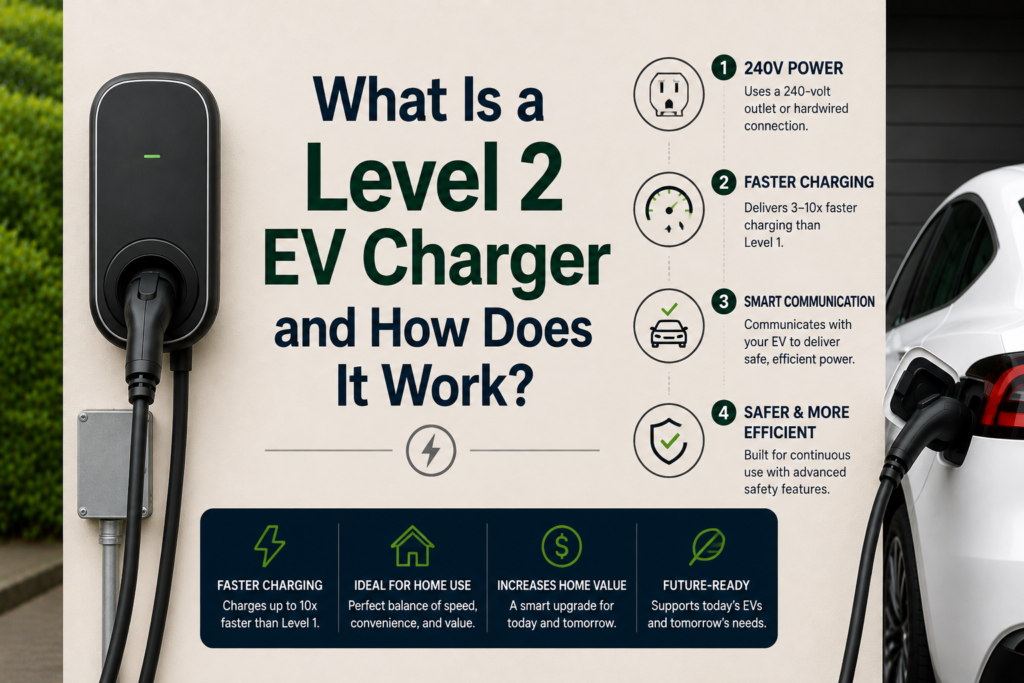
If you’re new to owning an electric vehicle, you’ve probably come across the term “Level 2 charger” more than once — on your car’s charging screen, in installer quotes, or in online forums. It’s the single most important piece of equipment for anyone who wants to charge their EV efficiently at home. This guide breaks down exactly what a Level 2 charger is, how it works, and why it matters for your daily charging routine.
What Does “Level 2” Actually Mean?
In the U.S., home and public EV charging is grouped into three official categories, based on the SAE J1772 standard:
- Level 1 — charging from a standard 120-volt household outlet, the same one you’d plug a lamp or a toaster into.
- Level 2 — charging from a 240-volt circuit, the same voltage used by a clothes dryer or an electric oven.
- DC Fast Charging (Level 3) — high-voltage charging found at public fast-charging stations, not available for home installation.
A Level 2 charger, then, is simply a charging unit designed to run on a 240-volt circuit. It’s not a different kind of electricity — it’s the same power your home already has, just delivered at a higher voltage and through dedicated equipment built for the job.
How a Level 2 Charger Works
At a basic level, a Level 2 charger acts as a controlled bridge between your home’s electrical panel and your car’s battery. Here’s the process step by step:
- Power draw: The charger pulls 240-volt AC power from a dedicated circuit in your electrical panel, typically rated between 30 and 60 amps depending on the model.
- Communication with the vehicle: Before any real charging begins, the charger and the car “talk” to each other through the charging cable, confirming things like maximum safe amperage, battery temperature, and charge status.
- AC-to-DC conversion: Electric vehicle batteries store energy as direct current (DC), but the power coming from your home is alternating current (AC). The car’s onboard charger — not the wall unit — converts the incoming AC power into DC power that the battery can actually store.
- Charging speed control: The charger continuously monitors the process, adjusting current flow to protect the battery and stop or slow charging as the battery approaches full capacity.
This is an important distinction: the wall-mounted or portable unit you buy is technically an “EV Supply Equipment” (EVSE), not a charger in the strictest sense — the real charger is built into the car itself. But in everyday language, “charger” is the term everyone uses, including manufacturers, so we’ll use it that way throughout this guide.
Why Level 2 Charging Is the Home Charging Standard
Level 1 charging works, but it’s slow — often adding only 3 to 5 miles of range per hour. For most daily driving needs, that’s simply not enough to reliably refill a battery overnight, especially for larger EVs or households with more than one electric vehicle.
Level 2 charging changes that equation dramatically. Depending on the amperage of your circuit and your vehicle’s onboard charger capacity, a Level 2 charger typically adds:
- 20–30 miles of range per hour for a standard 32-amp charger
- 30–45 miles of range per hour for a 40–48-amp charger
- Up to 60+ miles of range per hour for high-output setups paired with a vehicle that can accept that much power
In practice, this means most EV owners can go from a low battery to a full charge overnight — often in 4 to 8 hours — using a Level 2 charger, compared to 20+ hours with a standard household outlet.
Hardwired vs. Plug-In Level 2 Chargers
Level 2 chargers generally come in two installation types:
- Hardwired units are wired directly into your electrical panel by a licensed electrician, with no plug involved. They’re often considered more durable and are required by code in some jurisdictions for higher-amperage installations.
- Plug-in units connect to a dedicated outlet (commonly a NEMA 14-50, similar to what an RV or a large appliance might use). These are easier to relocate, upgrade, or take with you if you move.
Both types deliver the same charging technology — the difference is purely in how the unit connects to your home’s electrical system, which affects cost, flexibility, and installation complexity.
Do You Need an Electrician?
In almost all cases, yes. Installing a Level 2 charger means adding a new 240-volt, high-amperage circuit to your home, which is not a DIY-friendly project unless you’re a licensed electrician yourself. A professional will:
- Confirm your electrical panel has enough available capacity
- Run a dedicated circuit sized to the charger’s amperage
- Install the correct outlet or hardwire the unit according to local electrical code
- Pull any required permits and schedule inspection if applicable
We cover installation costs and what to expect from the process in more detail in our full guide to home EV charger installation.
Worked Example: How Long a Charge Takes
Take an EV with a 60 kWh usable battery, charging from 20% to 80%. That adds 60 × 0.60 = 36 kWh to the battery; with about 10% charging losses you need roughly 36 ÷ 0.90 = 40 kWh from the wall. Charging power is volts × amps ÷ 1,000.
| Charger | Power | Time for 36 kWh added |
|---|---|---|
| Level 1 (12 A × 120 V) | 1.44 kW | 27.8 hours |
| Level 2 (32 A × 240 V) | 7.68 kW | 5.2 hours |
| Level 2 (48 A × 240 V), car limited to 11 kW | 11.0 kW | 3.6 hours |
The car can never charge faster than its onboard charger allows, so check the kW rating in your owner’s manual — a 48 A charger only helps if the vehicle accepts about 11 kW or more.
Figures in this example are illustrative and rounded; your rates, vehicle and installation will differ.
Sources and Further Reading
- U.S. DOE Alternative Fuels Data Center — Charging Plug-In Electric Vehicles at Home
- ENERGY STAR — Certified Electric Vehicle Chargers
- U.S. EIA — Short-Term Energy Outlook: Electricity (residential prices)
Last reviewed: October 2026.
Key Takeaways
- A Level 2 charger uses a 240-volt circuit — the same voltage as a dryer or oven — instead of a standard 120-volt outlet.
- It doesn’t convert power itself; your car’s onboard charger handles the AC-to-DC conversion.
- Charging speed depends on both the charger’s amperage and what your specific EV can accept.
- Professional installation is strongly recommended, and often required by code, due to the high electrical loads involved.

