If you’ve been researching the federal tax credit for home EV chargers, there’s an important update: the program has expired for new installations. Here’s what happened, who can still claim it for a past installation, and where to look for savings now that this particular credit is off the table going forward.
Quick Answer
The federal Alternative Fuel Vehicle Refueling Property Credit (Section 30C), which covered a percentage of home EV charger equipment and installation costs, expired for installations completed after June 30, 2026. Legislation passed in mid-2025 accelerated the credit’s original sunset date. If your charger was installed on or before June 30, 2026, you may still be able to claim the credit on your tax return for that year using IRS Form 8911 — but any installation completed after that date is no longer eligible federally. State and utility rebates remain the primary source of EV charger savings going forward; see our EV charger incentive guides by state for current programs.
What This Credit Used to Cover
While it was active, the credit applied to:
- The cost of the EV charger (EVSE) itself
- Installation costs directly related to setting up the charger, including labor
- In some cases, related electrical work required specifically for the charger installation
It never applied to the cost of the electric vehicle itself — that was always a separate federal credit with its own eligibility rules and timeline.
Why the Credit Expired Early
The credit’s original framework, expanded under the Inflation Reduction Act of 2022, was intended to run for a longer period. However, subsequent legislation moved up the expiration date, and as of mid-2026, this credit — along with a related commercial charging credit — is no longer available for installations completed after June 30, 2026. This is a good reminder that federal incentive programs can change timeline with new legislation, sometimes with less advance notice than homeowners might expect.
Can You Still Claim It for a Past Installation?
If your home EV charger was installed and placed in service on or before June 30, 2026, you may still be eligible to claim the credit when filing your taxes for that tax year, provided you also met the credit’s other requirements while it was active — most notably, the location-based eligibility described below.
The Location Requirement That Applied While the Credit Was Active
This credit was never available nationwide, even before it expired. Eligibility was tied to specific census tracts — generally areas designated as non-urban or otherwise meeting specific criteria under the law. This meant two neighbors in different parts of the same city could have had different eligibility depending on which census tract their home fell into. If you’re claiming the credit for a qualifying past installation, you’ll still need to confirm your address was in an eligible tract at the time of installation, using the IRS/Department of Energy mapping tool.
How to Claim It for a Qualifying Past Installation
- Confirm your installation date was on or before June 30, 2026. Installations after this date do not qualify, regardless of location.
- Confirm your address was in an eligible census tract at the time of installation, using the IRS/DOE mapping tool.
- Gather your receipts and invoices for both the charger equipment and the installation labor.
- Complete IRS Form 8911 when filing your federal tax return for the year the charger was installed.
- Consult a tax professional, especially since this credit’s expiration is relatively recent and guidance on claiming it for the final eligible period may still be evolving.
Where to Look for Savings Now
With the federal credit no longer available for new installations, your realistic path to reducing home charger costs now runs through state and utility programs instead:
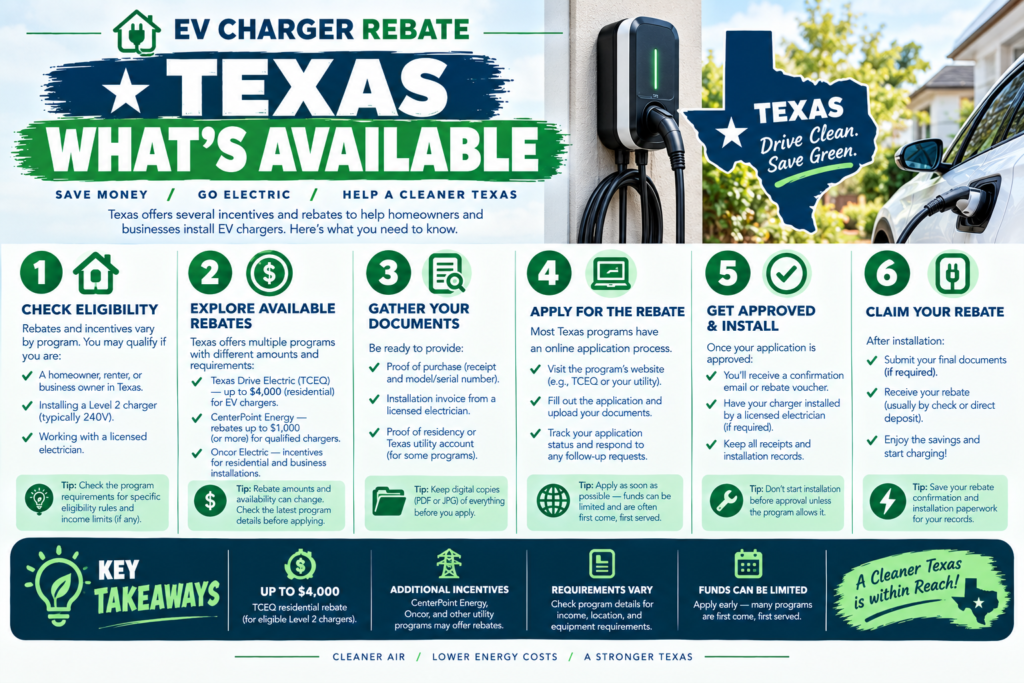
- State-specific incentives vary significantly — see our guides on EV charger rebates in California, Texas, and other states for what’s currently active.
- Utility company rebates remain a major source of savings in many areas, and unlike the federal credit, these programs operate on their own independent timelines rather than a single federal sunset date.
- Manufacturer or retailer promotions occasionally offer discounts on charger equipment, particularly around major shopping periods — see our guide on the best EV charger deals for Black Friday and Cyber Monday for seasonal opportunities.
Worked Example: Claiming for a Spring 2026 Installation
A homeowner in an eligible census tract had a charger installed and working on April 10, 2026. Their paperwork shows:
| Item | Amount |
|---|---|
| Charger (receipt) | $650 |
| Electrician invoice (circuit, labor, materials) | $1,250 |
| Qualifying cost | $1,900 |
| 30% of qualifying cost | $570 |
| Cap per item of property | $1,000 |
| Credit on Form 8911 (2026 return) | $570 |
Had the same charger been energized on July 1, 2026 — one day after the deadline — the federal credit would be $0. Keep the invoice that shows the completion date, the permit sign-off if you have one, and a screenshot of the census-tract eligibility check for your address.
Figures in this example are illustrative; this is not tax advice.
Sources and Further Reading
- U.S. DOE AFDC — Alternative Fuel Infrastructure Tax Credit (30C)
- IRS — About Form 8911, Alternative Fuel Vehicle Refueling Property Credit
- U.S. DOE AFDC — State Laws and Incentives
- DSIRE — Database of State Incentives for Renewables & Efficiency (NC State University)
Last reviewed: October 2026.
Key Takeaways
- The federal home EV charger tax credit (Section 30C, IRS Form 8911) expired for installations completed after June 30, 2026, following legislation that accelerated its original sunset date.
- Installations completed on or before that date may still qualify, provided the location-based eligibility requirement was also met.
- The credit was never available nationwide even while active — it was limited to specific census tracts.
- State and utility rebates are now the primary source of home EV charger savings, and these vary significantly and continue independently of the federal credit’s expiration.
Frequently Asked Questions
I installed my charger in early 2026 — can I still claim this credit? Possibly, if your installation was completed on or before June 30, 2026, and your address met the census tract eligibility requirement. Consult a tax professional to confirm your specific situation before filing.
Is there any indication this federal credit will return in the future? Federal incentive programs can be reinstated or replaced through new legislation, but there’s no guarantee of that happening. It’s best to plan your budget assuming this specific credit is not available, and treat any future reinstatement as a bonus rather than something to count on.
Does this expiration affect the separate EV purchase tax credit? Not necessarily — the vehicle purchase credit is a separate program with its own rules and timeline. Check current guidance specifically for that credit if you’re evaluating an EV purchase, since it follows a different legislative path than the charger installation credit covered here.