If you’ve bought or researched a home charger recently, you’ve likely run into some version of this question: should you worry about NACS, or just stick with the J1772 connector most non-Tesla chargers still use? Here’s what’s actually changing, what it means for your home charging setup, and what — if anything — you need to do about it right now.
Quick Answer
NACS (Tesla’s connector, now standardized industry-wide as SAE J3400) is rapidly becoming the new standard connector across North America, with more than 15 automakers — including Ford, GM, Hyundai-Kia, BMW, Mercedes-Benz, VW Group, Toyota/Lexus, Honda/Acura, Nissan, and Volvo/Polestar — having committed to it on 2025-2026 model year vehicles. J1772 remains the dominant AC connector on nearly all non-Tesla EVs sold through 2024 and continues to be widely used. For home charging specifically, this transition matters less than you might expect in the short term: most home chargers still use J1772, adapters are cheap and widely available, and millions of J1772-based vehicles will remain on the road for years.
How We Got Here
Tesla designed the NACS connector back in 2012 as a proprietary part of its Supercharger network — smaller and lighter than the industry-standard J1772/CCS combination, but limited to Tesla vehicles only. In late 2022, Tesla published the connector’s technical specifications publicly, and the SAE (Society of Automotive Engineers) moved unusually fast to formalize it as an open industry standard, designated SAE J3400, by 2024. Once the design became openly available to any manufacturer, automakers began announcing plans to adopt it rather than continue developing around the older J1772/CCS1 combination.
Why Automakers Are Actually Switching
A few genuine technical advantages are driving the industry-wide shift, not just Tesla’s market influence:
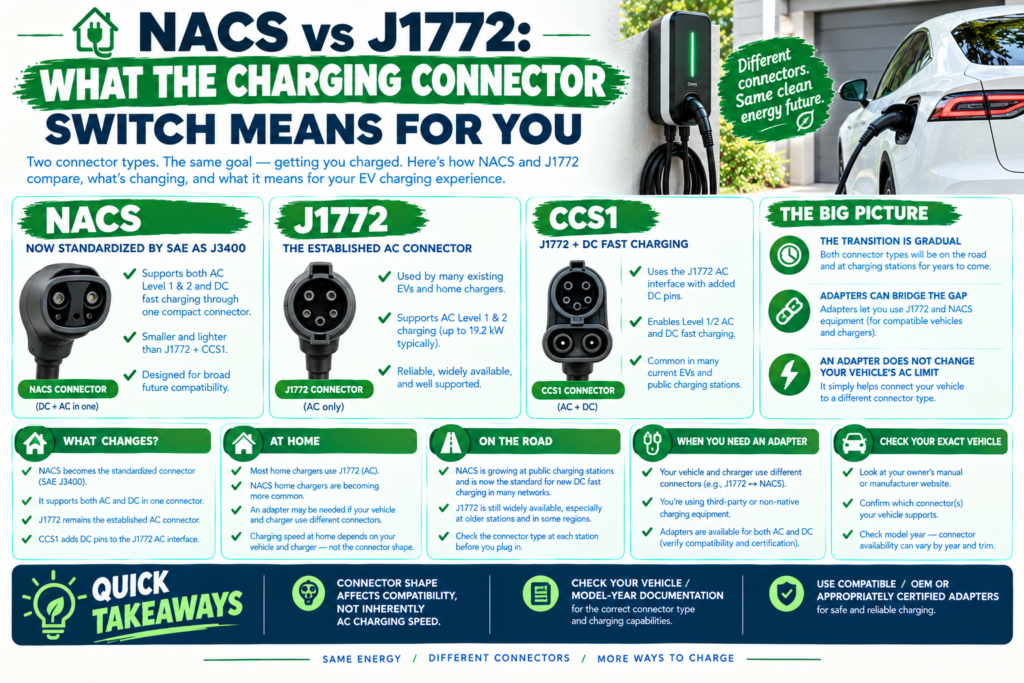
- One connector for both AC and DC charging. J1772 only handles AC (standard home and destination charging), requiring a separate, bulkier CCS1 port bolted on for DC fast charging. NACS handles both through a single, smaller port.
- Smaller, lighter connector. NACS is easier to handle and less bulky than the combined J1772/CCS1 design, a genuine ergonomic improvement drivers notice.
- Direct access to Tesla’s Supercharger network, one of the largest and most reliable fast-charging networks in North America — a major practical incentive for automakers whose customers previously couldn’t use it without an adapter.
What This Means for Your Home Charger
Here’s the part that matters most for a home charging decision: the vast majority of home Level 2 chargers on the market, including every model covered in our charger comparison guides, use the J1772 connector. This isn’t changing overnight, for a simple reason — J1772 remains the AC charging standard for nearly all EVs sold through model year 2024, and that installed base of vehicles isn’t disappearing.
If you’re buying a home charger in 2026:
- A J1772 charger (ChargePoint Home Flex, Emporia, Grizzl-E, Autel, Wallbox) works with virtually every non-Tesla EV on the road today, and with Tesla vehicles via the adapter Tesla includes with every car.
- A Tesla Wall Connector uses NACS natively, and works with non-Tesla EVs via a NACS-to-J1772 adapter — see our dedicated guide on the Tesla Wall Connector for non-Tesla EVs for the specifics.
- As newer NACS-native vehicles from other automakers arrive, they’ll typically still be able to use a J1772 home charger via an adapter, similar to how Tesla owners have used J1772 stations for years.
Do You Need to Buy a Different Charger Because of This Switch?
Not urgently, and not necessarily at all. A few practical points:
- Adapters are inexpensive and effective for AC home charging. NACS-to-J1772 adapters for Level 2 (AC) charging are widely available, generally in the $45-$85 range, and are standardized under the same SAE J3400 specification — this is a mature, well-supported solution, not a stopgap workaround.
- Your current J1772 charger isn’t becoming obsolete. Since NACS-native vehicles can charge on J1772 equipment via adapter, a J1772 home charger remains a fully functional, forward-compatible choice for years to come.
- If you’re buying your next vehicle new, check whether it ships with a NACS or J1772 port natively, since this affects which adapter (if any) you’ll want on hand — but it doesn’t change which home charger works for you.
Should This Change Which Charger You Buy Today?
For most buyers, no — choose based on the factors covered in our full guide to the best home EV chargers of 2026 (amperage, smart features, price) rather than connector type anxiety. The exception is if you specifically know you’re buying a NACS-native, non-Tesla vehicle very soon and want to minimize adapter use — in that narrow case, a Tesla Wall Connector or another NACS-compatible unit could make sense, though even then, a J1772 charger with an adapter remains a perfectly functional choice.
A Word on CCS1 (Not the Same as J1772)
It’s worth clarifying a common point of confusion: CCS1 is not the same as J1772 — it’s J1772’s AC connector with two additional DC pins added on, used specifically for public DC fast charging, not home Level 2 charging. Home chargers use the AC-only J1772 connector regardless of whether a vehicle also has a CCS1 DC fast-charging port. This distinction rarely matters for home charging decisions, but it explains why you might see “CCS1” mentioned in broader EV charging discussions without it being directly relevant to your home charger choice.
Worked Example: The Connector Doesn’t Set the Speed
At home, NACS and J1772 both carry AC power, and speed is set by the circuit and your car’s onboard charger. Adding 40 kWh from the wall (about 20% → 80% on a 60 kWh battery, with losses):
| Setup | Power | Time for 40 kWh |
|---|---|---|
| J1772 charger, 32 A | 7.68 kW | 5.2 hours |
| NACS charger, 32 A | 7.68 kW | 5.2 hours |
| J1772 charger + NACS adapter, 32 A (within adapter rating) | 7.68 kW | 5.2 hours |
| Either connector, 48 A, car accepts 11.5 kW | 11.52 kW | 3.5 hours |
The decision is about convenience and future vehicles, not charging time. If you use an adapter, make sure it is rated for at least the charger’s current and certified by a recognized testing lab.
Figures in this example are illustrative and rounded; your rates, vehicle and installation will differ.
Sources and Further Reading
- U.S. DOE Alternative Fuels Data Center — Charging Plug-In Electric Vehicles at Home
- ENERGY STAR — Certified Electric Vehicle Chargers
Last reviewed: October 2026.
Key Takeaways
- NACS, now standardized as SAE J3400, is becoming the industry-wide connector standard, with 15+ automakers committing to it for 2025-2026 model year vehicles.
- J1772 remains the dominant connector on the large existing fleet of non-Tesla EVs and on nearly all home Level 2 chargers currently sold.
- Inexpensive, standardized NACS-to-J1772 adapters make the transition low-friction for both AC home charging and public charging access.
- There’s no urgent need to change your home charger choice based on this transition — pick based on amperage, features, and price, and use an adapter if your specific vehicle’s connector doesn’t match your charger.
Frequently Asked Questions
Will J1772 chargers stop being supported or sold? Not in the near term — with millions of J1772-based vehicles still on the road and years of continued sales, J1772 charging equipment remains a mainstream, actively supported product category.
If I buy a NACS-native car, can I still use my existing J1772 home charger? Yes, using a NACS-to-J1772 adapter for AC (Level 2) charging, which is a standardized, widely available, and reliable solution for home charging speeds.
Is one connector actually safer than the other? No — both J1772 and NACS (SAE J3400) are recognized, standardized connectors with established safety requirements. The differences are in size, ergonomics, and AC/DC capability, not safety.