
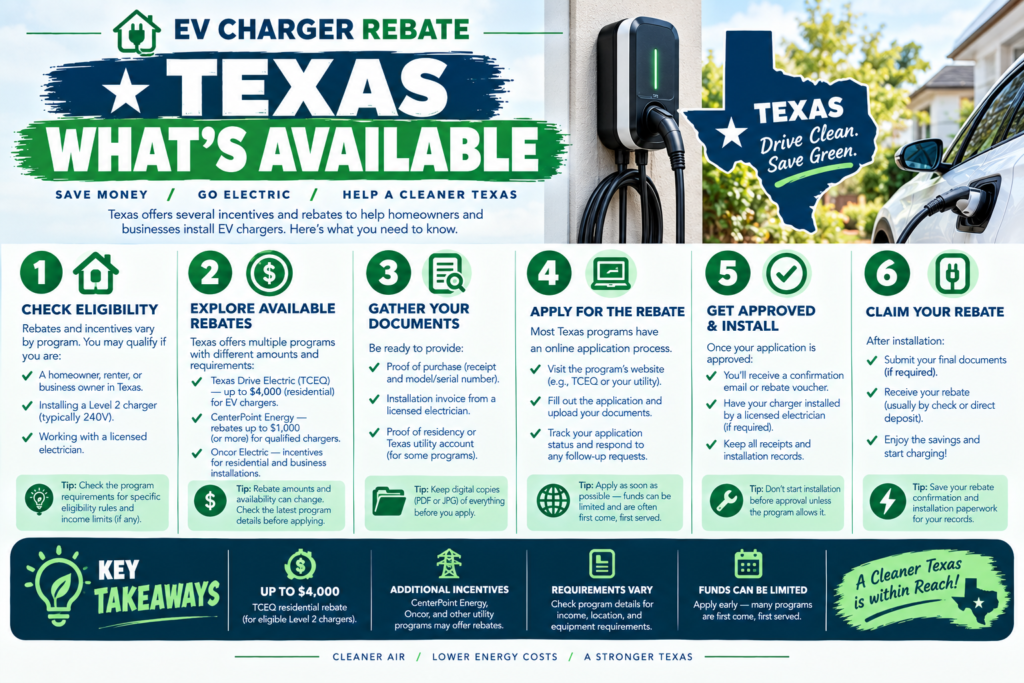
Texas takes a different approach than states like California: there’s no statewide charger rebate program, and incentives instead come entirely from individual utility companies and cooperatives. Here’s what’s actually available across the state and how to apply.
Quick Answer
Texas has no statewide home EV charger rebate. Instead, savings come from individual utility programs, which vary significantly by provider — ranging from roughly $200 to $1,200 depending on your electric company. Austin Energy currently offers one of the most generous programs, covering 50% of charger and installation costs up to $1,200. The federal home charger tax credit that many Texans previously relied on expired for installations completed after June 30, 2026, making these utility programs your primary source of savings going forward.
Texas Has No State-Level Charger Rebate
Unlike some states, Texas runs a single, relatively straightforward state-level EV program — the Light-Duty Motor Vehicle Purchase or Lease Incentive Program (LDPLIP), part of the Texas Emissions Reduction Plan (TERP) — but this grant applies to purchasing or leasing an eligible new EV, not to home charger installation. It’s worth knowing about since it can be combined with utility charger rebates (different funding sources, generally stackable), but it won’t directly offset your charger installation cost.
For charger-specific savings, you’ll need to look at your local utility.
Major Texas Utility Charger Rebate Programs
Austin Energy
Austin Energy offers one of the strongest charger rebates in the state: 50% of the cost to purchase and install a qualified Level 2 charging station, up to $1,200 for chargers compatible with Austin Energy’s managed charging program (Power Partner), or a somewhat lower cap for non-compatible stations. This is currently the most generous utility-level program identified in Texas.
CPS Energy (San Antonio)
CPS Energy runs its FlexEV program, which includes a bill-credit rebate for customers who install a smart Level 2 EV charging station, plus a separate bill credit specifically for charging during off-peak hours. CPS also offers an optional annual-fee program giving EV owners access to its public FlexEV charging network. Rebate amounts and program details have varied over time, so confirm current terms directly with CPS Energy before applying.
Entergy Texas
Entergy offers a rebate for residential customers purchasing a Level 2 EV charging station through its eTech program, covering part of the purchase and installation cost.
SWEPCO (Southwestern Electric Power Company)
SWEPCO offers a rebate for residential customers installing an ENERGY STAR-certified Level 2 EV charging station, available on a first-come, first-served basis while program funding lasts.
United Cooperative Services (UCS)
UCS offers eligible members a rebate covering roughly half the purchase cost of a qualifying Level 2 charger, up to a set cap, for homes served by the cooperative.
Why Utility Rebates Are Now More Important Than Ever
The federal Alternative Fuel Vehicle Refueling Property Credit (Section 30C) — which covered 30% of home charger equipment and installation costs, up to $1,000 — was available to Texas homeowners through June 30, 2026, but expired for installations completed after that date. See our federal tax credit guide for home EV chargers for background on how that credit worked while it was active, and our California rebate guide for how another major state is handling the same federal change. With that credit gone, your Texas utility’s own program is now the primary lever for reducing your total installation cost.
How to Apply
- Identify your electric utility or cooperative — Texas has a deregulated electricity market in many areas, but charger rebates are typically tied to your transmission and distribution utility (the company that actually delivers power to your home), not your retail electricity provider.
- Check your utility’s current program status and funding availability, since several Texas programs operate on a first-come, first-served basis and can pause when funds run out.
- Confirm equipment eligibility requirements, such as ENERGY STAR certification or compatibility with a specific managed-charging program, before purchasing your charger.
- Use a licensed installer and keep all receipts, since documentation is typically required to apply.
- Submit your application according to your utility’s specific process — some require pre-enrollment in a related program (like Austin Energy’s Power Partner) to access the higher rebate tier.
Can You Stack the LDPLIP Grant With a Charger Rebate?
Yes — the state’s LDPLIP vehicle grant and a utility’s home charger rebate are separate programs with different funding sources and different purposes (one for the vehicle, one for the charger), so they can generally be combined if you qualify for both. This means a Texas homeowner buying a new EV and installing a Level 2 charger could potentially combine the LDPLIP grant with a utility charger rebate, maximizing total savings across both purchases.
What This Means for Your Total Cost
Recent installation data shows the average cost of a Level 2 home charger installation in Texas is around $1,800, though total cost commonly ranges from $700 to $2,700 depending on your home’s existing electrical setup. With Austin Energy’s rebate, a qualifying homeowner could offset up to $1,200 of that cost — a meaningful reduction, though most other Texas utilities offer more modest amounts in the $200-$500 range. See our complete guide on home EV charger installation costs for a full breakdown of what drives your total price up or down.
Key Takeaways
- Texas has no statewide home charger rebate — savings depend entirely on which utility or cooperative serves your home.
- Austin Energy currently offers the most generous program (50% up to $1,200); most other Texas utilities offer $200-$500.
- The federal 30C tax credit expired for installations after June 30, 2026, making utility programs your main source of savings now.
- The state’s LDPLIP vehicle grant is a separate program from charger rebates and can generally be combined with one.
Frequently Asked Questions
How do I know which utility serves my home in a deregulated market? Charger rebates are typically administered by your transmission and distribution utility, not your retail electricity provider — check a recent electric bill, which usually lists both, to identify the right company to contact.
Is it too late to get the federal credit for a Texas charger installed in 2026? If your installation was completed on or before June 30, 2026, you may still be able to claim it for that tax year — consult a tax professional to confirm, since eligibility also depended on your address being in a qualifying census tract.
Do all Texas utilities offer a charger rebate? No — availability varies significantly. If your specific provider isn’t listed here, check their website directly, since program offerings and funding change over time.

