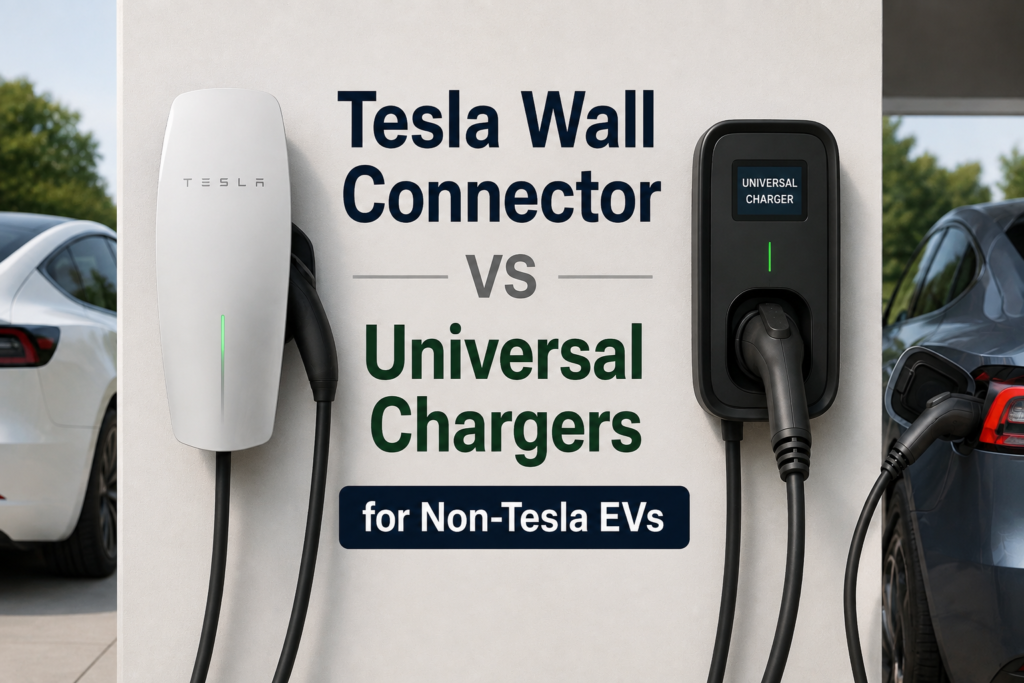
If you drive a non-Tesla EV, you’ve probably noticed the Tesla Wall Connector shows up in searches for “best home EV charger” — often at a lower price than universal alternatives. It’s a fair question: can you actually use it, and should you? Here’s a clear answer, specifically for non-Tesla EV owners.
Quick Answer
Yes, a Tesla Wall Connector can charge most non-Tesla EVs, but only with a NACS-to-J1772 adapter, and it comes with some real trade-offs in app functionality and long-term flexibility. For most non-Tesla EV owners, a universal J1772 charger (like a ChargePoint Home Flex, Emporia, or Grizzl-E) is the more practical choice — the Tesla Wall Connector only makes sense in specific situations covered below.
How Non-Tesla EVs Connect to a Tesla Wall Connector
The Tesla Wall Connector uses Tesla’s proprietary NACS (North American Charging Standard) connector. Since most non-Tesla EVs use the J1772 connector, you’ll need a NACS-to-J1772 adapter to physically plug in. Some newer non-Tesla EVs are beginning to ship with NACS ports directly as the industry shifts toward Tesla’s connector standard, which would remove the need for an adapter — check your specific vehicle’s charging port type before assuming you’ll need one.
What You Gain
- Lower price: the Tesla Wall Connector is often $100-$150 cheaper than comparable universal chargers with similar amperage and features.
- Solid build quality: it’s a well-reviewed, reliable piece of hardware regardless of which vehicle you’re charging.
- Compact design: it has a notably slim physical footprint compared to some universal competitors.
What You Give Up
- No dedicated app support for non-Tesla vehicles: the Tesla app is built around Tesla’s own vehicles, so features like charge scheduling, energy monitoring, and notifications may not function the same way, or at all, when charging a non-Tesla EV through an adapter.
- Hardwired only: the Tesla Wall Connector has no plug-in installation option, which can mean a somewhat higher installation cost and less flexibility than a universal charger with a plug-in configuration — see our hardwired vs. plug-in EV charger comparison for the full trade-offs.
- An extra adapter to manage: it’s one more piece of equipment to keep track of, and a potential (though uncommon) point of connection wear over time.
- Less certainty on long-term compatibility: if Tesla changes firmware behavior for third-party vehicles down the line, non-Tesla charging performance could theoretically be affected — a universal charger avoids this dependency entirely.
Charging Speed: Does It Actually Change?
No — the Tesla Wall Connector delivers standard Level 2 charging power (up to 48A) regardless of which EV you plug in, using the same underlying AC charging process. Your actual charging speed with a non-Tesla EV will be capped by your vehicle’s onboard charger limit, exactly as it would be with any other Level 2 charger. There’s no inherent speed penalty from using an adapter — the physical connection simply routes the same power through a different plug shape.
When It Actually Makes Sense for Non-Tesla Owners
- You want the lowest possible price for a reliable, well-built Level 2 charger and don’t need app-based scheduling or monitoring
- You’re comfortable without brand-specific app features and simply want dependable charging
- You already own the NACS-to-J1772 adapter for another reason (some Tesla-adjacent charging setups)
When a Universal Charger Makes More Sense
- You want full app functionality — scheduling, energy tracking, remote monitoring — for your specific vehicle
- You want the flexibility of a plug-in installation instead of hardwired-only
- You might switch to a different EV brand in the future and want a charger that stays fully functional without depending on adapter compatibility
- You want to avoid managing an additional adapter as part of your daily routine
Worked Example: Same Circuit, Same Speed
Connector brand doesn’t change physics: on the same circuit, a Tesla Wall Connector (with an adapter or a J1772 version) and a universal J1772 charger deliver the same power. Power = 240 V × amps; time = energy ÷ power. Adding 40 kWh from the wall:
| Circuit / setting | Power | Time for 40 kWh | Limited by |
|---|---|---|---|
| 40 A breaker / 32 A | 7.68 kW | 5.2 hours | Circuit |
| 60 A breaker / 48 A, car accepts 11.5 kW | 11.52 kW | 3.5 hours | Circuit |
| 60 A breaker / 48 A, car accepts 7.2 kW | 7.2 kW | 5.6 hours | Car’s onboard charger |
For a non-Tesla EV, the practical differences are the connector, the app and the warranty terms — not the charging speed.
Figures in this example are illustrative and rounded; your rates, vehicle and installation will differ.
Sources and Further Reading
- U.S. DOE Alternative Fuels Data Center — Charging Plug-In Electric Vehicles at Home
- ENERGY STAR — Certified Electric Vehicle Chargers
Last reviewed: October 2026.
Key Takeaways
- Non-Tesla EVs can charge on a Tesla Wall Connector using a NACS-to-J1772 adapter, with no reduction in charging speed.
- The main trade-offs are limited app functionality for non-Tesla vehicles and a hardwired-only installation.
- Universal chargers like ChargePoint, Emporia, or JuiceBox are generally the more practical choice for non-Tesla owners who want full smart features and installation flexibility.
- The Tesla Wall Connector’s lower price can still make sense if you specifically don’t need or want smart-charger features.
Frequently Asked Questions
Do I need to buy the NACS-to-J1772 adapter separately? It depends on your vehicle — many non-Tesla EVs include a compatible adapter with the car, or one can be purchased separately from the vehicle manufacturer or Tesla.
Will my car’s charging app still show accurate data through a Tesla Wall Connector?Charging data reported by your own vehicle’s app should still work normally, since that comes from the car itself — it’s specifically the Tesla Wall Connector’s own app features that may not fully support non-Tesla vehicles.
Are newer EVs moving away from needing this adapter? Yes — several automakers have announced plans to include native NACS charging ports on upcoming models, which would allow direct connection to Tesla Wall Connectors and Tesla Superchargers without an adapter.