
I
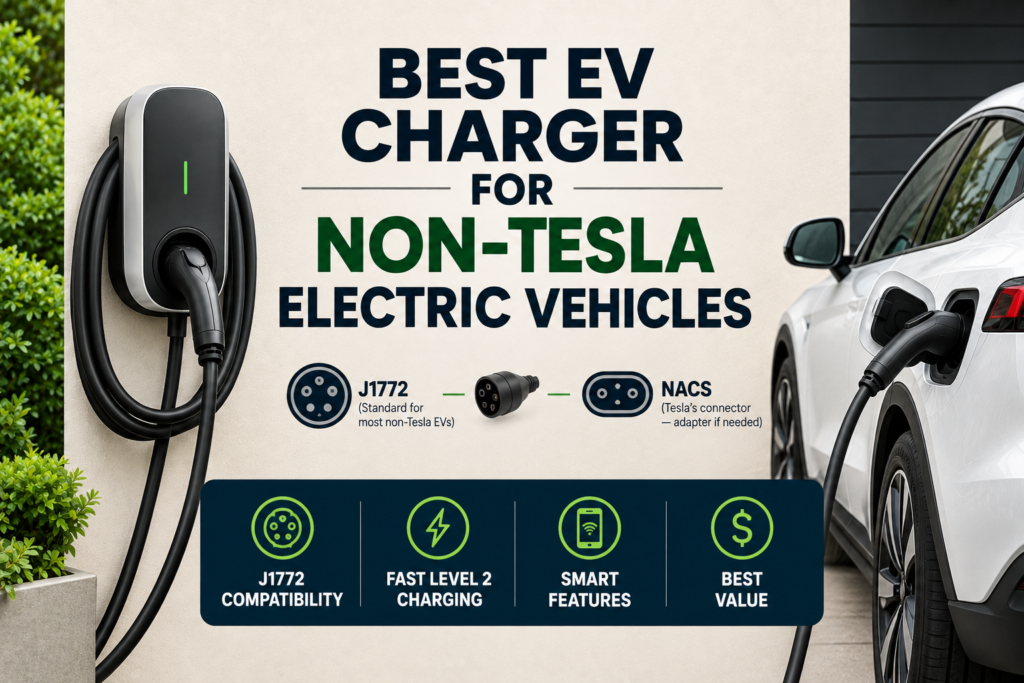
f you drive a Ford, Chevy, Hyundai, Kia, Rivian, or any other non-Tesla EV, you have the entire universal J1772 charger market to choose from — no adapters, no compatibility questions. That range of choice is great, but it also means the “best charger” really depends on what matters most to you: price, smart features, amperage, or build quality. Here’s how the top options compare.
Quick Picks
- Best overall: ChargePoint Home Flex
- Best budget: Grizzl-E Classic
- Best smart features for the price: Emporia EV Charger
- Best compact design: Wallbox Pulsar Plus
- Best rugged/outdoor: Autel MaxiCharger
- Best simple, no-app option: JuiceBox 40
Best Overall: ChargePoint Home Flex
Price: $500 – $650 | Max amperage: 50A (adjustable) | Installation: Hardwired or plug-in
The ChargePoint Home Flex remains the strongest all-around pick for non-Tesla EVs specifically because of its adjustable amperage range — you can configure it lower now and increase it later in the app if your panel or vehicle needs change, without buying new hardware. It also connects to the ChargePoint public network under the same account, a real convenience if you ever charge away from home on that network.
Best Budget: Grizzl-E Classic
Price: $270 – $400 | Max amperage: Up to 40A | Installation: Hardwired or plug-in
For non-Tesla owners who just want dependable Level 2 charging without paying for an app, the Grizzl-E Classic is hard to beat on price. It’s particularly well regarded for cold-weather durability, and its universal J1772 connector means zero compatibility concerns with any EV brand. Our Emporia vs Grizzl-E comparison covers exactly what smart features you’re skipping at this price.
Best Smart Features for the Price: Emporia EV Charger
Price: $350 – $450 | Max amperage: Up to 48A | Installation: Hardwired or plug-in
Emporia hits a strong middle ground: real-time energy monitoring, cost-per-charge tracking, and off-peak scheduling, at a price closer to budget chargers than to premium ones. It’s an especially good fit if your utility offers time-of-use electricity rates, since the scheduling feature can help you consistently charge during cheaper hours — see our WiFi-enabled vs. basic chargers comparison for how much that can matter financially.
Best Compact Design: Wallbox Pulsar Plus
Price: $550 – $700 | Max amperage: 48A | Installation: Hardwired or plug-in
If garage or wall space is limited, the Wallbox Pulsar Plus is one of the smallest Level 2 chargers available, without sacrificing amperage or app quality. It also uniquely supports power sharing between two units, which matters if your household has more than one non-Tesla EV on a shared circuit.
Best Rugged/Outdoor: Autel MaxiCharger
Price: $450 – $600 | Max amperage: 50A | Installation: Hardwired or plug-in
For a fully outdoor installation exposed to weather, the Autel MaxiCharger combines a weatherproof housing with the highest amperage in this list, at a price below several premium competitors. It’s a strong choice if you’re also considering a larger-battery EV or truck down the line, since the extra amperage headroom carries forward.
Best Simple, No-App Option (With Smart Features Available): JuiceBox 40
Price: $400 – $550 | Max amperage: 40A | Installation: Hardwired or plug-in
JuiceBox strikes a balance between Emporia’s value-smart approach and Grizzl-E’s bare-bones simplicity: it offers a clean, well-reviewed app experience without the deeper ecosystem tie-ins of ChargePoint or Wallbox. It’s a solid pick if you’ve already decided 40A covers your needs and want a straightforward smart charger without extra complexity. Our JuiceBox vs ChargePoint comparison covers the fuller feature differences.
How to Narrow It Down for Your Specific Vehicle
Since compatibility isn’t a concern with any of these picks (all use the universal J1772 connector), your decision should be based on:
- Amperage your vehicle can actually use — check your owner’s manual or manufacturer specs, and see our guide on how many amps you need for a home EV charger before overspending on capacity you can’t use.
- Whether your utility offers time-of-use electricity rates — if so, a scheduling-capable charger like Emporia, ChargePoint, or Wallbox can pay for itself over time.
- Your installation environment — fully outdoor installations favor Autel’s rugged design; space-constrained garages favor Wallbox’s compact size.
- How many EVs are in your household — multi-EV homes on a shared circuit should specifically evaluate Wallbox’s power-sharing feature before assuming a panel upgrade is necessary.
Key Takeaways
- Every charger on this list uses the universal J1772 connector, so compatibility isn’t a differentiating factor for non-Tesla EVs — price, features, and amperage are what matter.
- ChargePoint Home Flex remains the strongest all-around pick; Grizzl-E is the clear budget winner.
- Emporia offers the best smart-feature value, while Wallbox and Autel serve more specific needs (compact size and power sharing, or rugged outdoor durability).
- Match your pick to your utility’s rate structure and your vehicle’s actual onboard charging limit before paying for features or amperage you won’t use.
Frequently Asked Questions
Do I need a different charger for different non-Tesla EV brands? No — the J1772 connector is standardized across virtually all non-Tesla EVs sold in the U.S., so any charger on this list works the same way regardless of your specific vehicle brand.
Can these chargers be used with a Tesla too, if I switch vehicles later? Yes, using the J1772-to-Tesla adapter Tesla includes with every new vehicle, making any of these a safe long-term choice even if your household eventually adds a Tesla.
Is a higher price always worth it for a non-Tesla EV owner? Not necessarily — the price difference between these chargers mostly reflects smart features, amperage range, and design, not charging safety or core reliability, all of which are solid across every pick on this list.

