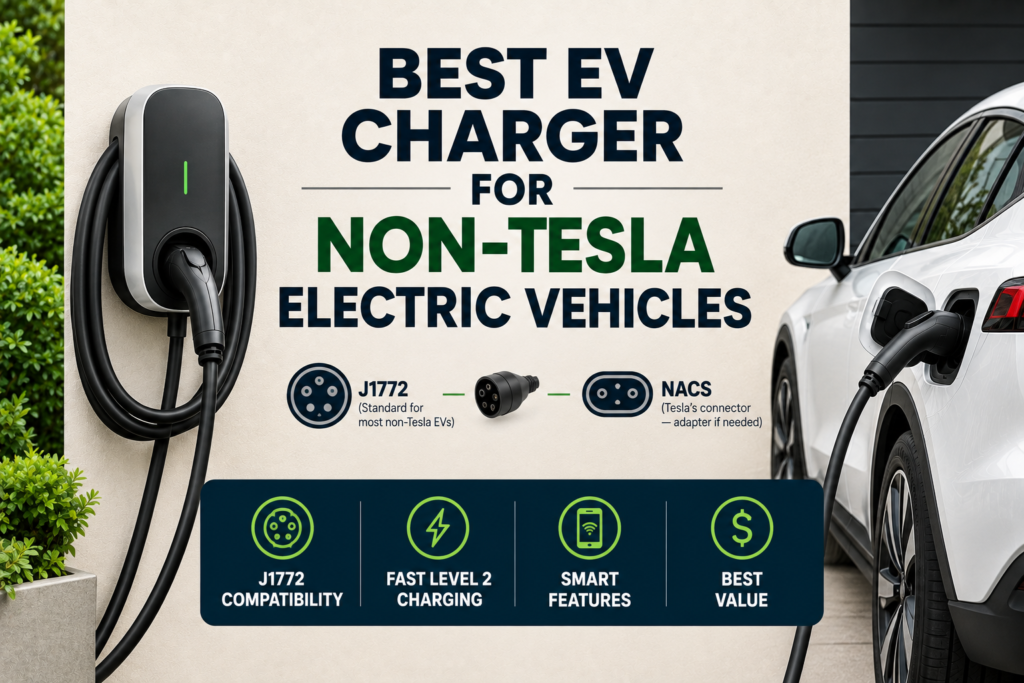
Tesla owners have an advantage most other EV buyers don’t: the option to use a charger built specifically for their car, alongside a full range of universal chargers that work equally well through Tesla’s included adapter. Here’s how to choose the right one for your situation, with specific picks for different priorities.
Quick Picks
- Best overall for Tesla: Tesla Wall Connector
- Best if you might add a non-Tesla EV: ChargePoint Home Flex
- Best budget option: Grizzl-E Classic
- Best smart features: Emporia EV Charger
- Best for two Teslas on one circuit: Wallbox Pulsar Plus
Best Overall for Tesla: Tesla Wall Connector
Price: $400 – $450 | Max amperage: 48A | Installation: Hardwired only
For a Tesla-only household, this is the simplest and often cheapest path to a fully featured home charger. It integrates directly with the Tesla app for scheduling, charge history, and remote monitoring — no adapter, no third-party app, no compatibility questions. The only real limitation is that it’s hardwired-only, so plan for a slightly higher installation cost than a plug-in alternative. Our full ChargePoint Home Flex vs Tesla Wall Connector comparison covers how it stacks up against the leading universal option if you want a second opinion.
Best If You Might Add a Non-Tesla EV: ChargePoint Home Flex
Price: $500 – $650 | Max amperage: 50A (adjustable) | Installation: Hardwired or plug-in
If there’s a real chance your household will add a non-Tesla EV — a second car, a future upgrade, or a partner’s vehicle — a universal charger avoids the adapter dependency entirely. The ChargePoint Home Flex works natively with any J1772 vehicle and with Tesla via the included adapter, all while matching or exceeding the Tesla Wall Connector’s amperage. You’ll pay more upfront, but you won’t need to replace the charger if your garage stops being Tesla-only.
Best Budget Option: Grizzl-E Classic
Price: $270 – $400 | Max amperage: Up to 40A | Installation: Hardwired or plug-in
Tesla owners who don’t need app-based scheduling can save meaningfully with the Grizzl-E Classic. It charges just as reliably as pricier smart options — your Tesla’s own onboard systems already handle charge scheduling and monitoring through the car itself, which covers many of the same needs a smart charger app would otherwise provide. See our Emporia vs Grizzl-E comparison for what you’re trading off at this price point.
Best Smart Features: Emporia EV Charger
Price: $350 – $450 | Max amperage: Up to 48A | Installation: Hardwired or plug-in
If you want a dedicated charger app in addition to Tesla’s own vehicle app — useful for tracking home energy costs specifically, rather than just vehicle charge data — Emporia is a strong pick at a lower price than most other smart chargers. It pairs especially well if you already use Emporia’s whole-home energy monitoring hardware.
Best for Two Teslas on One Circuit: Wallbox Pulsar Plus
Price: $550 – $700 per unit | Max amperage: 48A | Installation: Hardwired or plug-in
Multi-Tesla households charging on a shared circuit face the same electrical constraints as any two-EV home. Two Wallbox Pulsar Plus units can automatically balance power between them, which can help you avoid a costly panel upgrade compared to running two full-amperage circuits. Our Autel vs Wallbox comparison covers this power-sharing feature in more detail.
Do You Even Need a Tesla-Specific Charger?
Not necessarily. Since Tesla vehicles use the J1772-to-Tesla adapter included with every new car, any universal charger on this list works perfectly well with a Tesla — the Tesla Wall Connector’s advantage is really about price and native app integration, not charging capability or speed. Your decision should come down to:
- Price and simplicity → Tesla Wall Connector
- Future flexibility for other EV brands → a universal charger like ChargePoint or Emporia
- Lowest possible cost → Grizzl-E
- Multi-vehicle power sharing → Wallbox
Worked Example: Overnight Charging for a Tesla
Suppose you drive 40 miles a day and your Tesla uses about 0.28 kWh per mile. That is 40 × 0.28 = 11.2 kWh in the battery, or about 11.2 ÷ 0.90 = 12.4 kWh from the wall with charging losses.
| Charging option | Power | Time to replace 40 miles | Breaker |
|---|---|---|---|
| Mobile connector, 120 V outlet (12 A) | 1.44 kW | 8.6 hours | 15–20 A existing |
| Mobile connector / NEMA 14-50 (32 A) | 7.68 kW | 1.6 hours | 40–50 A |
| Wall Connector (48 A) | 11.52 kW | 1.1 hours | 60 A |
For a typical commute, any Level 2 option refills the day’s driving in under two hours; faster hardware mainly helps on days when you arrive home nearly empty or share the charger between two cars.
Figures in this example are illustrative and rounded; your rates, vehicle and installation will differ.
Sources and Further Reading
- U.S. DOE Alternative Fuels Data Center — Charging Plug-In Electric Vehicles at Home
- ENERGY STAR — Certified Electric Vehicle Chargers
- NFPA 70, National Electrical Code (Article 625 covers EV charging equipment)
Last reviewed: October 2026.
Key Takeaways
- The Tesla Wall Connector is the simplest, often cheapest choice for Tesla-only households, but it’s hardwired-only.
- Universal chargers work equally well with Tesla vehicles via the included adapter, and offer better long-term flexibility if you might add another EV brand.
- Your Tesla’s own app already covers much of what a smart charger app would otherwise provide, which can make a basic charger like Grizzl-E a smart way to save money.
- Multi-Tesla households should consider power-sharing chargers like Wallbox before assuming a panel upgrade is required.
Frequently Asked Questions
Does charging speed differ between the Tesla Wall Connector and a universal charger? No — both deliver standard Level 2 power up to their rated amperage. Your actual speed depends on your circuit’s amperage and your Tesla’s onboard charger limit, not the brand of charger.
Will I lose any Tesla app features by using a universal charger instead of the Wall Connector? No — your Tesla’s own charging data, scheduling, and monitoring come from the car itself through the Tesla app, regardless of which Level 2 charger you use.
Is it worth paying more for a universal charger if I’m certain I’ll always own a Tesla?Not necessarily — if you’re confident your household will remain Tesla-only, the Tesla Wall Connector typically offers the best value with no meaningful downside.