The charger itself is only part of the total bill. The real cost of home EV charging depends heavily on your electrical panel, the distance between the panel and where you park, and what your local permit office requires. This guide breaks down each cost component, shows sample scenarios, and explains where you can save — and where you shouldn’t.
Quick Answer
Most homeowners spend roughly $600 to $2,500 in total for a Level 2 charger, including the unit itself. Installations that need a panel upgrade or a long wire run can reach $2,500 to $4,500 or more. The biggest variables are your panel’s available capacity and the distance from the panel to the charger.
Full Cost Breakdown
| Component | Typical range | When it applies |
|---|---|---|
| Level 2 charger (32–48 A) | $270 – $700 | Always |
| Standard installation (panel has capacity, short run) | $300 – $800 | Most homes |
| Longer wire run (30+ ft from the panel) | $500 – $1,200 | Detached garages, far parking spots |
| Permit and inspection | $50 – $300 | Required in most jurisdictions |
| Panel upgrade | $1,500 – $3,000 | Panel lacks capacity |
| Subpanel (alternative to a full upgrade) | $800 – $2,000 | Space or distance constraints |
What Drives the Cost Up or Down
1. Distance From the Panel to the Charging Location
Every extra foot of heavy-gauge copper wire and conduit adds material and labor. Long runs may also need a larger wire size to limit voltage drop, which raises the price further.
2. Whether Your Panel Has Available Capacity
A charger set to 40 A needs a 50 A breaker and draws 9.6 kW for hours at a time. An electrician confirms whether your panel can handle that with a load calculation. If it can’t, the options are a lower amp setting, a load-management device, a subpanel or a service upgrade.
3. Hardwired vs. Plug-In Installation
Plug-in chargers on a NEMA 14-50 outlet are often slightly cheaper to install and easy to replace, but they’re limited to 40 A. Hardwired units allow up to 48 A on a 60 A circuit and usually take a little more labor.
4. Permit and Inspection Requirements
Most cities and counties require a permit for a new 240 V circuit. Fees vary widely by municipality, and some utilities and rebate programs require proof of a permitted, inspected installation.
5. Local Labor Rates
Electrician rates differ significantly between regions, which is why the same job can cost hundreds of dollars more in a high-cost metro area.
6. Indoor vs. Outdoor Installation
Outdoor installations need weather-rated equipment and fittings, and sometimes trenching, which adds cost compared with mounting inside an attached garage.
Sample Cost Scenarios
| Scenario | Charger | Installation | Permit | Extra work | Total |
|---|---|---|---|---|---|
| Attached garage next to the panel, no upgrade | $400 | $400 | $100 | — | $900 |
| Detached garage 40 ft away, no upgrade | $450 | $400 | $150 | $550 longer run | $1,550 |
| Older 100 A panel needing an upgrade | $450 | $500 | $200 | $2,400 panel upgrade | $3,550 |
Ways to Lower Your Installation Cost
- Choose the amperage you actually need. A 32 A charger on a 40 A circuit covers most commutes overnight and may fit a panel that a 48 A unit wouldn’t.
- Get at least three quotes from licensed electricians, ideally ones with EV charger experience.
- Ask about load management as an alternative to a full panel upgrade.
- Check state and utility rebates before you buy — some require specific models or pre-approval.
- Consider plug-in instead of hardwired where your code allows it and 40 A is enough.
Don’t Skip These Steps to Save Money
- Skipping the permit can cause problems with insurance claims, rebates and home sales.
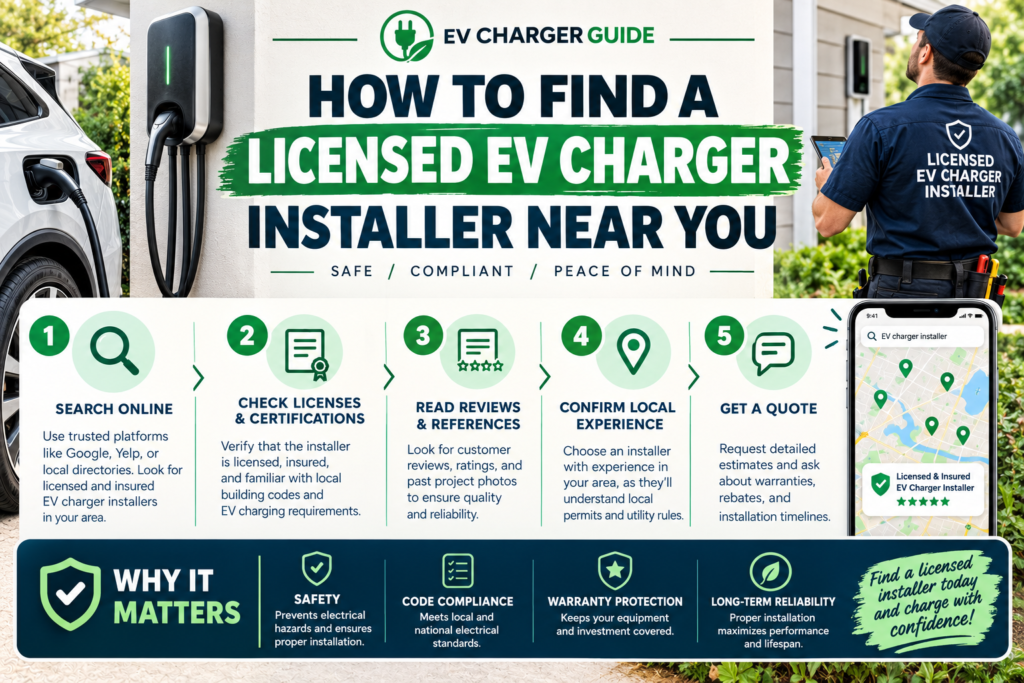
- Hiring an unlicensed installer puts safety, warranty and code compliance at risk.
- Undersizing the circuit to avoid an upgrade creates an overheating risk; set the charger to no more than 80% of the breaker rating instead.
Worked Example: Net Cost and Payback
Take a mid-range installation — illustrative numbers, use your own quotes:
| Item | Amount |
|---|---|
| Level 2 charger | $600 |
| New 50 A circuit, 30 ft run, materials and labor | $1,050 |
| Permit and inspection | $150 |
| Total before incentives | $1,800 |
| Utility or state rebate (if available) | −$500 |
| Net cost | $1,300 |
Driving 12,000 miles a year at 3.5 miles per kWh takes about 3,429 kWh. Home charging at 18¢/kWh (with 10% charging losses) costs about $686 a year, versus about $1,646 at an illustrative 48¢/kWh public fast-charging price — a difference of roughly $960 a year, so the $1,300 net cost is recovered in about 1.4 years. The federal 30C credit only covered chargers placed in service on or before June 30, 2026, so look to state and utility programs instead.
Figures in this example are illustrative and rounded; your rates, vehicle and installation will differ.
Key Takeaways
- Most installations total $600–$2,500 including the charger; panel upgrades or long runs push costs to $2,500–$4,500+.
- Panel capacity and distance from the panel are the two biggest cost drivers.
- A lower amp setting or load management can often avoid an expensive upgrade.
- Never skip the permit or a licensed electrician to save money.
Frequently Asked Questions
Can I install the charger myself to save money? You can do some prep work, but the electrical connection should be done by a licensed electrician, and most jurisdictions require a permit and inspection for a new 240 V circuit.
Do installation costs vary by state? Yes — mainly through local labor rates and permit fees. The equipment costs about the same everywhere.
Should I upgrade my panel now if I don’t strictly need to? It can make sense if you plan to add a second EV, a heat pump or solar soon, since doing the work once is usually cheaper than doing it twice.
Sources and Further Reading
- U.S. DOE Alternative Fuels Data Center — Charging Plug-In Electric Vehicles at Home
- U.S. DOE AFDC — State Laws and Incentives
- DSIRE — Database of State Incentives for Renewables & Efficiency (NC State University)
- U.S. DOE AFDC — Alternative Fuel Infrastructure Tax Credit (30C)
- NFPA 70, National Electrical Code (Article 625 covers EV charging equipment)
Last reviewed: October 2026.