“Smart charger” gets used a lot in product listings, but it’s worth understanding exactly what that label means before deciding whether it’s worth paying for. Here’s a clear explanation of what smart chargers actually do, and a straightforward way to figure out if you need one.
Quick Answer
A smart EV charger connects to your home WiFi and a companion app, adding features like charging schedules, remote start/stop, and energy usage tracking on top of standard Level 2 charging. You need one if you want to shift charging to cheaper off-peak electricity hours, track charging costs, or control charging remotely. You likely don’t need one if you charge at the same time every night, have a flat electricity rate, and don’t care about usage data — a basic charger delivers identical charging performance for less money.
What “Smart” Actually Means
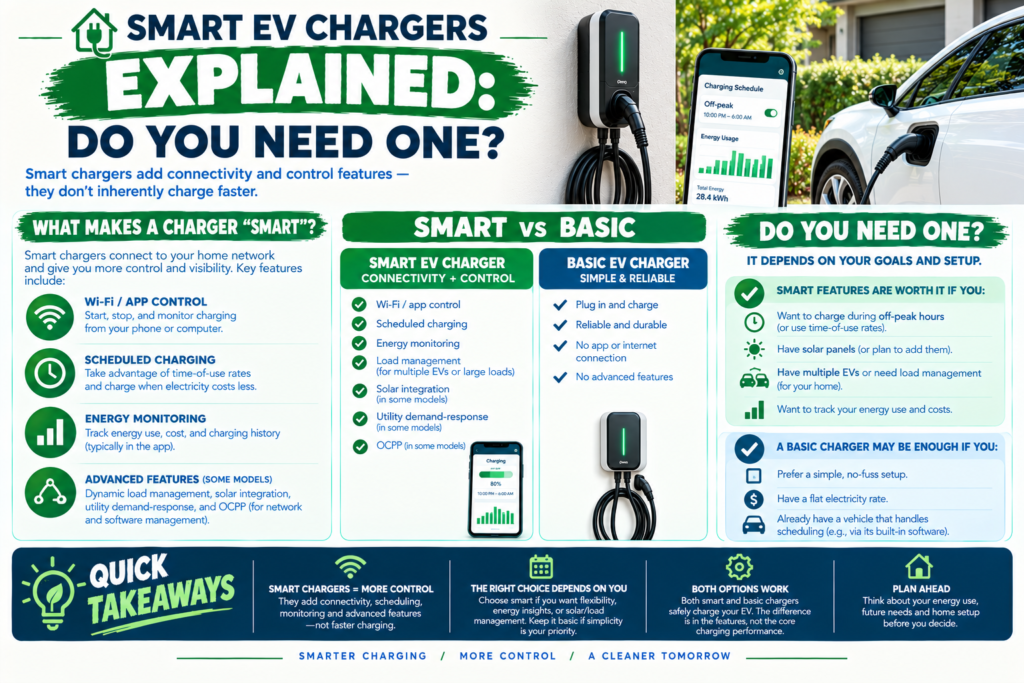
At its core, a smart charger is a standard Level 2 charger with WiFi connectivity and a companion app layered on top. The actual charging hardware — the part that safely delivers power to your vehicle — isn’t fundamentally different from a basic charger’s. The “smart” label refers entirely to the added software and connectivity layer, which typically includes:
- Charging schedules — automatically start or stop charging during specific hours
- Remote control — start, stop, or check charging status from your phone, from anywhere with an internet connection
- Energy usage tracking — see kWh used per session, and sometimes an estimated cost
- Notifications — alerts when charging starts, completes, or is interrupted unexpectedly
- Firmware updates — delivered automatically over WiFi, sometimes adding new features over time
How This Differs From a Basic Charger
A basic (non-smart) charger charges at a fixed, pre-configured amperage with no app, no WiFi, and no remote features — you plug in, it charges, and that’s the entire interaction. Amperage on basic chargers is typically set once during installation via internal dip switches, rather than adjusted regularly through software. See our WiFi-enabled vs. basic chargers comparison for a deeper look at this specific trade-off.
The Single Biggest Reason to Want a Smart Charger: Time-of-Use Electricity Rates
This is the most concrete, financially measurable benefit a smart charger offers. Many utility companies charge significantly less per kWh during off-peak hours (commonly overnight), and some offer EV-specific rate plans that reward or require off-peak charging. A smart charger’s scheduling feature lets you consistently charge during the cheapest hours without having to remember to plug in at a specific time each night.
Check your specific utility’s rate structure before assuming this applies to you — if you’re on a flat rate with no time-of-use option, this particular financial benefit doesn’t exist, and the case for a smart charger becomes about convenience rather than savings.
Other Genuine Benefits of Smart Charging
- Multi-driver households can track which sessions belong to which vehicle (on chargers supporting multiple profiles), useful for splitting electricity costs fairly
- Remote troubleshooting lets you check charging status without walking out to the garage, particularly useful in bad weather or if you’re away from home
- Energy budgeting becomes easier with detailed per-session cost data, especially if you’re trying to understand your EV’s actual impact on your electricity bill
- Firmware improvements mean your charger can gain new features over time without needing to buy new hardware
When a Smart Charger’s Features Go Unused
It’s worth being honest about how many smart charger owners never fully use the scheduling and monitoring features they paid extra for. If you already know your daily routine involves plugging in at roughly the same time every night, and you’re not on a time-of-use rate plan, a smart charger’s most valuable features may simply sit unused — in which case, the price premium isn’t buying you much in practice.
A Simple Decision Framework
Ask yourself these three questions:
- Does my utility offer time-of-use or EV-specific electricity rates? If yes, a smart charger’s scheduling can generate real, ongoing savings.
- Do I want to track energy costs or usage data for budgeting purposes? If yes, this is a genuine smart-charger benefit with no basic-charger equivalent.
- Would I actually use remote start/stop or notifications regularly? If you’re unsure, consider whether this is a “nice to have” you’d use occasionally versus something central to your daily routine.
If you answered yes to the first or second question, a smart charger likely justifies its price premium. If none of these resonate, a basic charger delivers the same core charging experience for meaningfully less money.
Key Takeaways
- A smart charger adds WiFi connectivity, scheduling, remote control, and usage tracking on top of standard Level 2 charging hardware — the core charging performance isn’t different from a basic charger.
- The clearest financial case for going smart is access to time-of-use electricity rates through your utility.
- Many smart charger features go underused by owners with consistent daily charging routines and flat electricity rates.
- The right choice depends on your specific utility’s rate structure and how much you value monitoring and remote control, not on any safety or reliability difference.
Frequently Asked Questions
Does a smart charger charge faster than a basic charger? No — charging speed depends on amperage and your vehicle’s onboard charger, not on WiFi connectivity or app features. A smart and basic charger at the same amperage charge at the same speed.
Can I add smart features to a basic charger later? No — smart connectivity is built into the charger’s hardware, so upgrading requires replacing the unit rather than adding a feature to an existing basic charger.
Do smart chargers require an ongoing subscription fee? Most major brands do not charge a subscription for core home charging features like scheduling and monitoring, though it’s worth confirming for the specific model you’re considering.