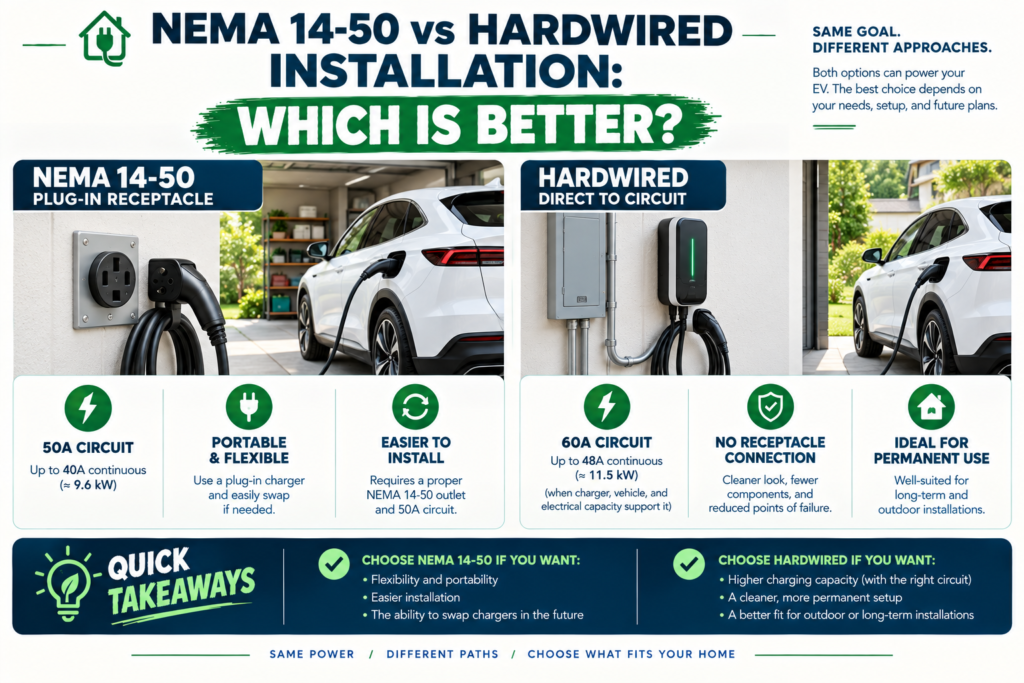
This comparison comes up constantly once you’ve picked a charger model, since many popular units are available in both configurations. It’s essentially a more detailed look at the same core decision covered in our general hardwired vs. plug-in guide, but focused specifically on the NEMA 14-50 outlet, since it’s become the de facto standard for plug-in Level 2 charging. Here’s what actually differs.
Quick Answer
A NEMA 14-50 plug-in installation is generally cheaper, more flexible, and easier to upgrade or relocate later, while a hardwired installation offers a marginally more permanent, code-preferred setup for higher-amperage circuits in some jurisdictions. For most homeowners planning to stay in their home long-term with a standard 32-40A charger, either option performs identically — the decision usually comes down to cost, flexibility preference, and your specific charger model’s available configurations.
What Makes NEMA 14-50 the Standard Plug-In Choice
The NEMA 14-50 outlet is rated for up to 50 amps and includes a neutral wire, which some charger models specifically require for their internal electronics. It’s also a well-established outlet type already familiar to electricians due to its long-standing use for RVs, welders, and other high-draw equipment — meaning parts, installation knowledge, and troubleshooting expertise are all widely available, unlike some less common outlet types.
Side-by-Side Comparison
| NEMA 14-50 (Plug-In) | Hardwired | |
|---|---|---|
| Installation cost | Generally lower | Generally higher |
| Portability | High — charger can be unplugged and moved | None — permanently connected |
| Charger swap/upgrade | Simple, no electrician needed | Requires electrician for any change |
| Max amperage support | Up to 50A | Varies by charger, often similar range |
| Code acceptance | Universal | Universal, sometimes preferred at higher amperages |
| Failure point | One additional connection (outlet/plug interface) | None — direct connection |
| Common use case | Most residential installations | Higher amperage circuits, permanent installations, some Tesla Wall Connector setups |
Cost Difference in Practice
A NEMA 14-50 plug-in installation typically costs less because it’s a more standardized, well-understood job for electricians — running a dedicated outlet circuit is generally simpler than a full hardwired connection requiring direct termination at both the panel and the charger. The exact difference varies by home and electrician, but plug-in installations commonly run $200-$500 less than a comparable hardwired job — see our complete guide on home EV charger installation costs for full pricing scenarios.
Flexibility: Where NEMA 14-50 Clearly Wins
If you anticipate any of the following, a plug-in NEMA 14-50 setup offers real practical advantages:
- Moving homes — you can take the charger with you, leaving only the outlet behind
- Upgrading chargers — swapping to a newer model or different brand doesn’t require an electrician, just unplugging one unit and plugging in another
- Troubleshooting — you can test the outlet independently of the charger, or temporarily use the outlet for another purpose (like an RV) if needed
- Uncertainty about your final charger choice — you can install the outlet now and decide on or change your specific charger model later without redoing electrical work
When Hardwired Still Makes Sense
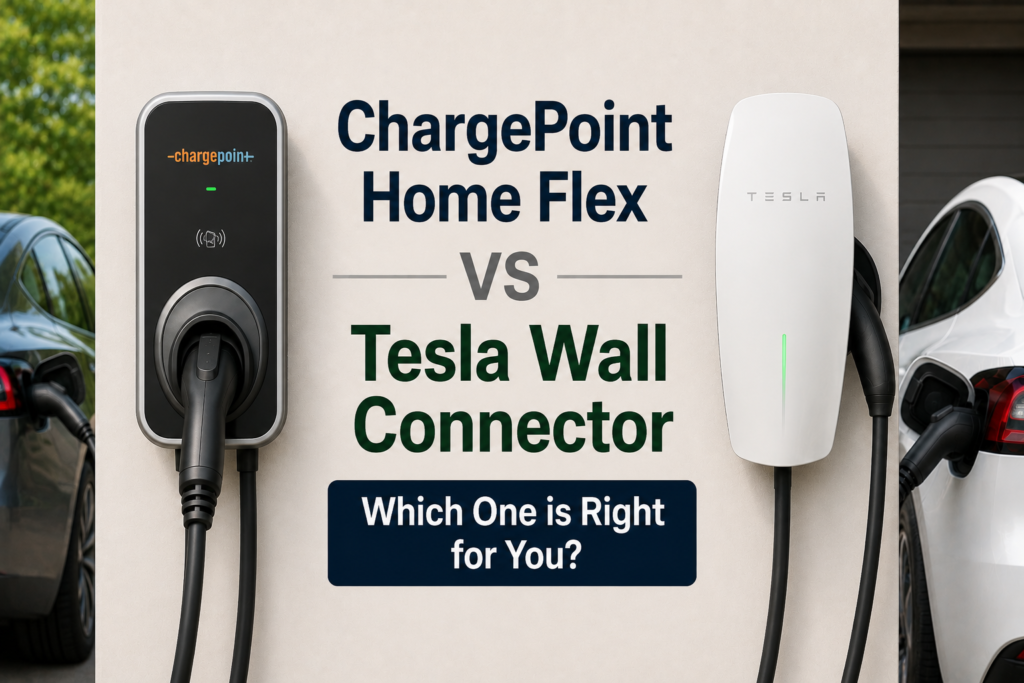
- Your preferred charger is hardwired-only, like the Tesla Wall Connector — see our Tesla Wall Connector vs ChargePoint Home Flex comparison for how this affects your choice
- Local code specifically requires or favors hardwiring at your planned amperage, particularly for higher-amperage installations (48-60A) in certain jurisdictions
- You want the cleanest possible aesthetic, with no visible outlet or plug, which matters to some homeowners for a more finished, built-in appearance
- You’re doing new construction or a larger remodel, where the incremental labor cost difference is smaller relative to the overall project
Does NEMA 14-50 Introduce Any Real Safety Concern?
Not when installed correctly. The connection point between the plug and outlet is a standard, well-engineered interface used reliably in millions of RV and appliance installations for decades. The only genuine consideration is ensuring proper installation (correct wire gauge, secure connections, GFCI protection where required) and periodic inspection for wear — the same care that applies to any electrical installation, hardwired or not. See our guide on 240V outlets for EV chargers for the full installation and safety considerations specific to this outlet type.
Key Takeaways
- NEMA 14-50 plug-in installations are generally cheaper and offer meaningfully more flexibility for moving, upgrading, or troubleshooting.
- Hardwired installations are marginally more permanent and are required for certain hardwired-only charger models like the Tesla Wall Connector.
- Neither option has a safety or charging-speed disadvantage when properly installed — the decision comes down to cost, flexibility, and your specific charger model.
- Most homeowners planning a standard 32-40A installation can choose based on preference and cost alone, without a strong technical reason to favor one over the other.
Frequently Asked Questions
Can I switch from hardwired to a NEMA 14-50 plug-in setup later? Yes, though it requires an electrician to modify the existing circuit termination — it’s not a simple DIY change, but it’s a straightforward project for a licensed electrician if you decide to add flexibility later.
Does a NEMA 14-50 outlet wear out faster than a hardwired connection? Not under normal use with quality components — this is a widely used, well-tested outlet standard. Periodic visual inspection as part of routine maintenance is still a good practice, covered in our guide on how to maintain your home EV charger.
Is NEMA 14-50 the only plug-in option for EV chargers? No — some chargers support NEMA 6-50 or other outlet types, but 14-50 has become the most common due to its widespread availability, higher amperage rating, and inclusion of a neutral wire that some chargers require.