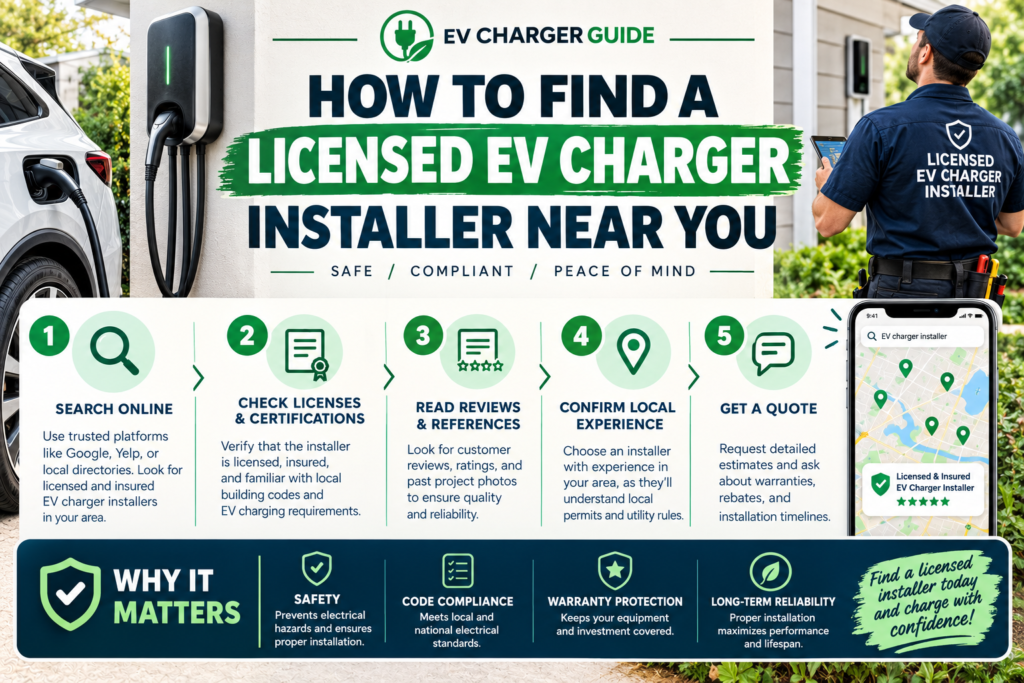
Not every licensed electrician has significant EV charger experience, and the gap between a generalist and a specialist can show up in your cost, how quickly the job gets done, and how well panel-capacity questions are handled. Here’s how to find, vet and compare installers in your area.
Quick Answer
Start with your charger manufacturer’s installer network, cross-check candidates against online reviews and your state’s electrical contractor license database, and get at least three quotes. Favor the electrician who can clearly explain their load calculation over the one with the lowest bid.
Where to Start Looking
- Manufacturer installer networks. Brands such as ChargePoint, Emporia and Tesla maintain directories of vetted installers. Check the “installation” or “find an installer” section of your charger brand’s website first.
- Your state’s contractor license lookup. Every state has a public database. Use it to confirm a license is active and in good standing — even for personal referrals.
- Online reviews. Search “[your city] EV charger installation” rather than just “electrician” to find people with relevant, recent reviews.
- Your utility. Some utilities publish approved contractor lists, and some rebate programs require an approved installer — check before you hire.
What to Ask Before Hiring
- Are you licensed and insured for residential electrical work in this state?
- Have you installed this specific charger model before?
- Will you do a load calculation before quoting?
- Does the quote include the permit and inspection, or are they billed separately?
- What’s the timeline from quote to passed inspection?
- Can you share references from recent EV charger jobs?
Red Flags to Watch For
- Reluctance to do a load calculation, or calling it unnecessary.
- A quote far below the others with no clear explanation — it can mean skipped permits, cheaper materials or inexperience with the required amperage.
- No mention of permits.
- Pressure to decide on the spot.
- Being unable to explain, in plain language, why they recommend a particular amperage or circuit size.
How Many Quotes Should You Get?
Three is a sensible standard: it shows the fair local price range and exposes outliers that are unusually high or low. If your job involves a panel upgrade or a long wire run, make sure each installer you ask has handled that kind of work.
Home-Service Marketplaces
General home-service platforms let you request several quotes at once, which saves time. Their vetting varies, though, so verify each license yourself and ask the questions above before committing.
What a Good Installer Checks Before Quoting
- Your panel’s rating and available capacity
- The distance from the panel to the charging spot
- Indoor or outdoor installation
- Existing large loads (range, dryer, heat pump, water heater) that affect the load calculation
- Your municipality’s permit requirements
If a quote arrives without any of this, ask how the price and timeline were worked out.
Worked Example: Comparing Three Quotes Line by Line
Three illustrative quotes for the same job — a 40 A charger on a new 50 A circuit, 35 feet from a 200 A panel:
| Quote A | Quote B | Quote C | |
|---|---|---|---|
| Labor and materials | $950 | $1,100 | $600 |
| Permit and inspection | $150 included | $150 included | Not mentioned |
| Breaker size stated | 50 A | 50 A | 40 A |
| Load calculation | Yes | Yes | “Not needed” |
| Comparable total | $1,100 | $1,250 | $600 + $150 permit = $750, but undersized |
Quote C looks $350 cheaper, but a 40 A charger needs a 50 A breaker (40 ÷ 0.8), so a 40 A breaker would either trip or force you to limit charging to 32 A. Combined with no permit and no load calculation, it’s the riskiest choice. Quote A is the best value here.
Figures in this example are illustrative and rounded; your rates, vehicle and installation will differ.
Key Takeaways
- Start with the manufacturer’s installer network, then confirm the license in your state’s database.
- Ask about load calculations, permits and experience with your exact charger model.
- Get at least three quotes and be wary of bids that skip permits or load calculations.
- A good installer assesses your panel and site before quoting.
Frequently Asked Questions
Is it worth paying more for an EV-experienced electrician? Often, yes. Experience with your charger and EV circuit sizing can mean faster work and fewer surprises, especially around panel capacity.
Can my regular electrician install a charger if they’ve never done one? Yes, if they’re licensed for residential work. EV circuits follow standard electrical code, though specific experience can make the job smoother.
Do utility rebates require a specific installer? Sometimes. Requirements vary by program, and using a non-approved installer could disqualify you, so check before you hire.
Sources and Further Reading
- U.S. DOE Alternative Fuels Data Center — Charging Plug-In Electric Vehicles at Home
- NFPA 70, National Electrical Code (Article 625 covers EV charging equipment)
- U.S. Consumer Product Safety Commission — Electrical Safety
Last reviewed: October 2026.

