
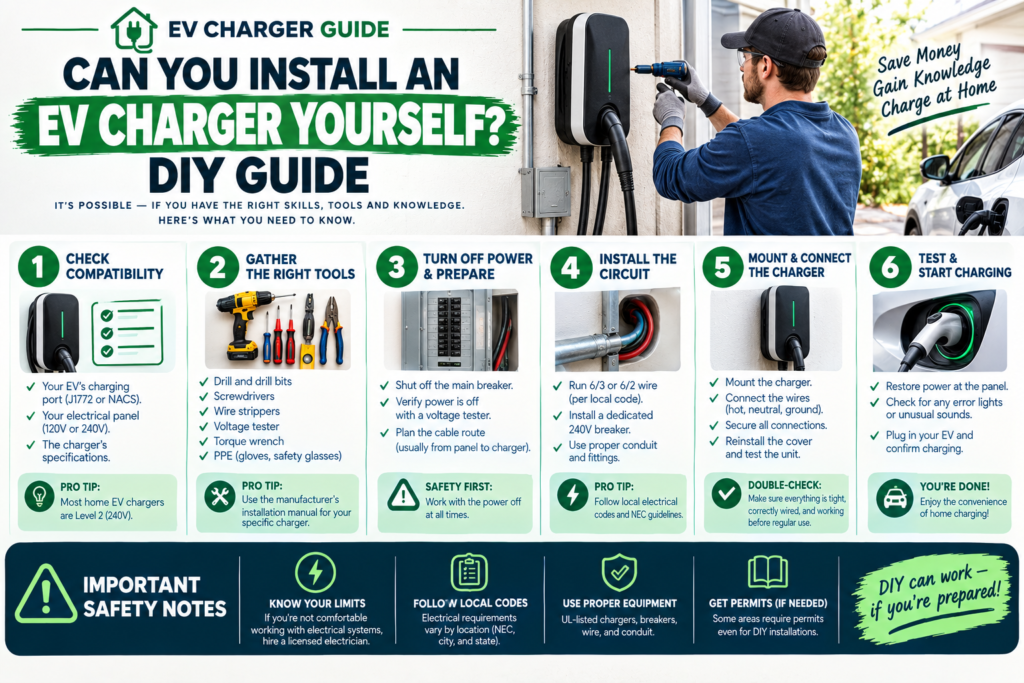
If you’re comfortable with home improvement projects, it’s natural to wonder how much of an EV charger installation you can handle yourself. The honest answer is: some parts, but not the part most people assume. Here’s a clear breakdown of what’s realistic to DIY, what isn’t, and why.
Quick Answer
The electrical connection itself — running a new 240V circuit, connecting to your panel, and wiring the charger or outlet — should be done by a licensed electrician in almost all cases, both for safety and because most jurisdictions legally require it for permitted electrical work. What you can often DIY: mounting the charger unit itself (once wiring is in place), running non-electrical prep work, and in some cases, simply plugging a portable charger into an already-existing, correctly rated outlet.
Why the Electrical Work Itself Isn’t a Good DIY Project
EV charger circuits are not a typical outlet or light fixture installation. They involve:
- High continuous amperage (30-60A) sustained for hours at a time, which creates real fire risk if wiring, connections, or breaker sizing are done incorrectly
- 240V circuits, which carry significantly more danger than standard 120V household wiring if handled improperly
- Code compliance requirements (NEC Article 625 specifically addresses EV charging equipment) that most homeowners aren’t familiar with in detail
- Permit and inspection requirements that, in most jurisdictions, legally require the work to be performed or supervised by a licensed electrician
Beyond the legal requirement in most areas, this is also simply not a place where the potential cost savings are worth the safety risk — mistakes in high-amperage circuit work can cause house fires, not just a malfunctioning outlet.
What You Can Realistically DIY
1. Mounting the Charger Unit (After Wiring Is Complete)
Once your electrician has installed the outlet or hardwired connection point, physically mounting the charger’s housing to the wall is often something handy homeowners can do themselves, following the manufacturer’s mounting instructions — though many electricians include this as part of their standard service anyway.
2. Site Preparation
Clearing the installation area, patching drywall in preparation for conduit, or prepping a mounting surface are all reasonable DIY tasks that can reduce your electrician’s on-site time (and potentially your labor cost).
3. Using a Portable Charger With an Existing Outlet
If you already have a properly installed, correctly rated 240V outlet (from a prior dryer or RV setup, for example, confirmed safe for this use by an electrician), simply plugging in a portable Level 2 charger designed for that outlet type doesn’t involve new electrical work — see our guide to the best portable Level 2 EV chargers for options built for this scenario.
4. App Setup and Configuration
Once the charger is physically installed, connecting it to WiFi, setting up scheduling, and configuring the companion app are all straightforward homeowner tasks with no electrical risk involved.
What Definitely Requires a Licensed Electrician
- Installing a new 240V circuit or outlet
- Any modification to your electrical panel, including capacity assessments and upgrades
- Hardwiring a charger directly to your electrical system
- Any work requiring a permit in your jurisdiction (which, as covered in our permit guide, applies to nearly all new EV charger circuits)
The Real Cost-Benefit of Attempting DIY Electrical Work
Even setting aside safety and legal requirements, the potential savings from DIY electrical work are smaller than they might appear:
- Materials (wire, breaker, outlet or hardwire connectors) typically represent a modest portion of total installation cost — most of the cost is labor and expertise
- Mistakes can be expensive to correct, sometimes more expensive than simply hiring a professional from the start, especially if drywall or finished surfaces need to be reopened
- Unpermitted work can create the insurance and resale complications covered in our permit guide, which can far outweigh any labor savings
A Reasonable Middle Ground
If cost is a major concern, a more realistic way to save money is:
- Get multiple electrician quotes rather than assuming the first one is the market rate
- Handle your own site prep and post-wiring charger mounting to reduce billable labor hours
- Choose a lower-amperage setup if it avoids a costly panel upgrade, rather than trying to DIY around that cost
- Ask your electrician directly which parts of the job, if any, they’re comfortable having you handle to reduce the bill
Key Takeaways
- The core electrical work — new circuits, panel connections, hardwiring — should be done by a licensed electrician, both for safety and because it’s legally required in most areas.
- Homeowners can often DIY charger mounting, site prep, and app setup without safety or legal concerns.
- A portable charger plugged into an existing, properly rated outlet doesn’t require new electrical work, but confirming that outlet’s safety and rating should still involve a professional if there’s any doubt.
- Real cost savings are more achievable through comparing electrician quotes and handling non-electrical tasks yourself than through DIY wiring.
Frequently Asked Questions
Is it illegal to do the electrical wiring myself? In most jurisdictions, yes, for anything requiring a permit — which applies to nearly all new EV charger circuits — unless you are yourself a licensed electrician performing the work on your own property, and even then, permit and inspection requirements typically still apply.
Can I get in trouble for DIY electrical work if no one finds out? The risk isn’t primarily about getting caught — it’s the safety hazard of improperly installed high-amperage wiring, plus the insurance and resale complications that surface later if the work is ever discovered, particularly after a fire, an insurance claim, or a home sale inspection.
What if I’m an electrician myself, just not licensed in this state? Licensing requirements are typically state-specific, so even qualified electrical experience in one state doesn’t necessarily meet legal requirements in another — check your specific state’s licensing rules before performing any of your own electrical work.

