
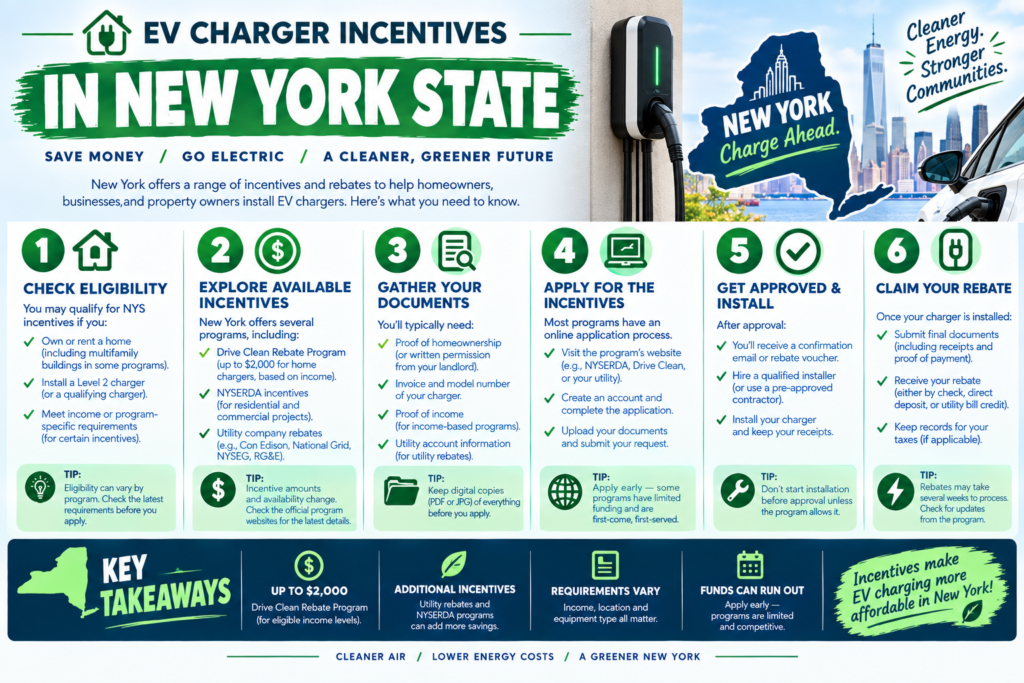
New York stands out from many states by offering its own state-level tax credit for home EV chargers, separate from the now-expired federal credit — plus a number of utility-specific rebates layered on top. Here’s how the pieces fit together.
Quick Answer
New York offers a state income tax credit (Form IT-253) covering a percentage of qualified EV charging equipment costs for personal use installations, claimed on your New York State tax return — this is separate from the federal credit and continues to apply regardless of the federal program’s expiration. In addition, several New York utilities, including NYSEG and PSEG Long Island, offer their own home charger rebates, typically in the range of $25 to $400 depending on the provider. Reports on utility program availability vary, so always confirm current offerings directly with your specific utility before purchasing.
New York State Tax Credit: Form IT-253
New York’s Alternative Fuels and Electric Vehicle Recharging Property Credit, claimed using Form IT-253, allows individual taxpayers to claim a credit equal to a percentage of the cost of qualified EV charging equipment installed at a personal residence, up to a set dollar cap. This is a state-level credit, entirely separate from the federal Alternative Fuel Vehicle Refueling Property Credit that expired for installations after June 30, 2026 — meaning New York homeowners can still claim this state credit going forward regardless of that federal change.
Because credit percentages and caps can be adjusted through state legislation, confirm the current-year figures directly through the New York State Department of Taxation and Finance’s instructions for Form IT-253, or with a qualified tax professional, before filing.
Utility-Specific Rebate Programs
NYSEG OptimizEV Program
New York State Electric and Gas (NYSEG) offers a rebate for residential Level 2 EV chargers, generally structured as a modest per-charger amount that can cover a meaningful share of material costs. Eligible chargers typically need to be networked (WiFi-enabled) and appear on the program’s approved equipment list, which has included models from Autel, Emporia, Tesla, and Wallbox among others — confirm your specific charger model qualifies before purchasing.
PSEG Long Island Smart Charger Rebate
Customers in PSEG Long Island’s service territory can apply for a rebate on a qualifying Level 2 home charger, with the standard rebate amount and a higher tier for customers in designated Disadvantaged Communities or enrolled in the utility’s Household Assistance Program. PSEG Long Island typically requires choosing a charger from its vetted product list (based on Electric Power Research Institute standards) and allows applying either instantly through an online marketplace at time of purchase, or afterward with a sales receipt and photo of the installed charger.
Other New York Utilities
Beyond NYSEG and PSEG Long Island, availability and amounts vary by provider across the state’s other utilities (such as RG&E, National Grid, and Con Edison territories). Some published reports indicate limited or no residential charger rebate in certain New York utility territories, while others list active programs — this inconsistency reflects how frequently these programs change. Always check your specific utility’s current EV or charging-equipment rebate page directly, rather than relying on a single source, since offerings can be added, paused, or discontinued with limited notice.
Charge Ready NY 2.0: Not for Single-Family Homes
You may come across NYSERDA’s Charge Ready NY 2.0 program in your research, which offers a substantial per-port rebate for installing Level 2 chargers. It’s important to know this program is targeted at public parking facilities, workplaces, and multi-unit dwellings (MUDs) — not single-family residential installations. If you live in a condo, apartment building, or your property manages shared parking, this program may be relevant to your building’s management rather than to an individual homeowner installation; see our guide on the best EV charger for multi-family homes and apartments for more on this scenario specifically.
How to Apply
- Confirm your utility’s current residential charger rebate status directly on their website, since program availability varies and changes over time.
- Check equipment eligibility requirements — several New York utility programs require networked, WiFi-enabled chargers from an approved list.
- Keep your purchase receipt and installation documentation, required for both utility rebate applications and the state tax credit.
- File Form IT-253 with your New York State income tax return for the year the equipment was placed in service, to claim the state tax credit.
- Consult a tax professional if you’re combining the state credit with a utility rebate and other applicable credits, to make sure you’re calculating everything correctly.
Does the New York State Credit Stack With Utility Rebates?
Generally yes — the state tax credit and a utility rebate come from different sources (state tax law versus a specific utility’s program) and are typically structured to be combinable. This means a New York homeowner could potentially claim a utility rebate for part of their upfront cost and still claim the state tax credit on their return for the qualifying equipment cost. Confirm with your specific utility whether their program has any unique restriction on stacking with state tax credits, since individual program rules can vary.
What This Means for Your Total Cost
Recent installation data shows the average cost of a Level 2 home charger installation in New York running higher than the national average, partly reflecting the state’s generally higher electrician labor costs. Between a New York State tax credit and a utility rebate where available, a homeowner can realistically offset a meaningful portion of that cost — though exact combined savings depend heavily on your specific utility and current program terms. See our complete guide on home EV charger installation costs for more on what drives regional cost differences.
Key Takeaways
- New York offers its own state tax credit (Form IT-253) for home EV charger equipment, separate from and unaffected by the federal credit’s expiration.
- Utility rebates vary significantly across the state — NYSEG and PSEG Long Island both offer documented residential programs, though amounts and availability change.
- NYSERDA’s Charge Ready NY 2.0 program targets public, workplace, and multi-unit dwelling installations, not single-family homes.
- Always verify current program details directly with your utility and the NYS Department of Taxation and Finance before finalizing your installation budget.
Frequently Asked Questions
Is the New York state tax credit affected by the federal credit’s expiration? No — Form IT-253 is a separate state-level credit under New York law and continues to apply regardless of the federal Alternative Fuel Vehicle Refueling Property Credit’s June 30, 2026 expiration.
What if my utility isn’t NYSEG or PSEG Long Island? Check your specific utility’s website directly for any current EV charger rebate — availability and terms vary significantly across New York’s various utility territories, and not every utility currently offers a residential program.
Can renters in New York access any of these incentives? The state tax credit and most utility rebates are generally available to whoever pays for and installs the qualifying equipment, which can include renters with landlord permission — though multi-family and rental scenarios have their own considerations, covered in our guide on the best EV charger for multi-family homes and apartments.

