Cable length is one of those specs that’s easy to overlook until you’re standing in your garage realizing the charger you bought doesn’t quite reach your car’s charging port. Here’s how to get it right the first time.
Quick Answer
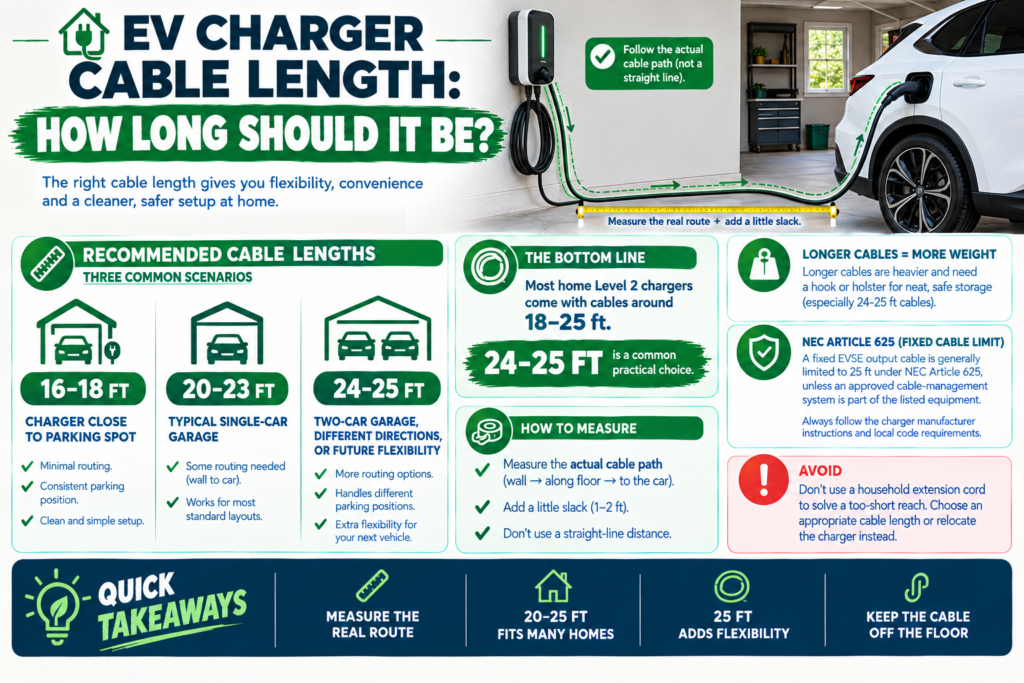
Most home EV chargers come with a cable between 18 and 25 feet, which is enough for the vast majority of single-vehicle garage or driveway installations. The right length for you depends on where the charger will be mounted relative to where your vehicle parks and where its charging port is located — measure this distance before choosing a charger rather than assuming a standard length will work.
Why Cable Length Matters More Than It Seems
Unlike a phone charger where an extra foot of cable is a minor inconvenience, EV charging cables are thick, semi-rigid, and not something you want to stretch taut or leave lying across a walkway. A cable that’s too short forces awkward parking angles or makes the charger unusable from certain positions, while a cable that’s excessively long creates more slack to manage, store, and protect from wear.
How to Measure What You Actually Need
- Identify your charger’s mounting location — the wall, post, or pedestal position you plan to install it in.
- Identify where your vehicle typically parks, accounting for how it’s usually pulled in (nose-in vs. back-in, and which side of the garage or driveway).
- Locate your vehicle’s charging port position — this varies significantly by manufacturer. Common locations include the driver’s side rear (many Teslas), passenger’s side rear, or front-mounted (some models).
- Measure the direct distance from the proposed mounting point to where the charging port will sit when the car is parked normally, adding a few extra feet for a natural, non-taut cable arc rather than a straight-line measurement.
Common Charging Port Locations by Approach
Since charging port position varies by brand and even by model, it’s worth checking your specific vehicle before assuming a typical layout:
- Driver’s side, rear — common on many Tesla models
- Passenger’s side, rear — common on several other EV brands
- Front-mounted — used by some models, offering more flexible parking orientation relative to the charger’s position
If your household includes multiple EV brands or you’re planning for a future vehicle purchase, consider a slightly longer cable to accommodate different possible port locations without needing to remount the charger later.
Standard Cable Lengths by Popular Charger Model
| Charger | Typical cable length |
|---|---|
| ChargePoint Home Flex | 23 ft |
| Tesla Wall Connector | 24 ft |
| Emporia EV Charger | 24 ft |
| Grizzl-E Classic | 24 ft |
| JuiceBox 40 | 25 ft |
| Autel MaxiCharger | 25 ft |
| Wallbox Pulsar Plus | 25 ft |
Most chargers on the market cluster in a fairly narrow 23-25 foot range, which reflects a practical industry standard for typical residential installations rather than significant variation between brands.
When You Might Need a Longer Cable
- Detached garage or carport situations where the charger is mounted at some distance from where the vehicle actually parks — see our guide on installing an EV charger in a detached garage for related considerations
- Shared driveways or multi-vehicle households where the charger needs to reach more than one possible parking position
- Charger mounted on an exterior wall away from the primary parking spot, such as near a garage door rather than directly beside where the car sits
What to Do If No Standard Cable Reaches Far Enough
If your specific layout genuinely requires more reach than standard charger cables provide, options include:
- Relocating the charger’s mounting point closer to your typical parking position, if feasible — often simpler and safer than trying to extend cable reach
- Repositioning where you park, if there’s flexibility in how the vehicle is pulled into the space
- Consulting your electrician about a different mounting location entirely, potentially closer to the panel or a more central point relative to parking
Avoid using an extension cord with a Level 2 charger under any circumstance — this is explicitly warned against by charger manufacturers and represents a genuine fire risk, since these cables aren’t rated for the sustained high-amperage current an EV charger delivers.
Managing Extra Cable Length
If your installation includes more cable than you typically need for a specific parking position, proper cable management matters for both safety and longevity:
- Use the charger’s built-in cable holder or wall mount, if included, rather than letting excess cable coil on the ground
- Avoid tight coiling, which can stress the internal wiring over time — a loose, natural arc is better than a tightly wound loop
- Keep excess cable off walkways and away from areas where it could be run over or caught in a vehicle door
See our guide on how to maintain your home EV charger for more on protecting your cable from unnecessary wear.
Worked Example: Measuring the Cable Length You Need
Measure the path the cable will actually follow, not the straight line. For a charger on the side wall of a garage and a car with its port on the far front corner:
| Segment | Length |
|---|---|
| Charger holster down to the floor | 4 ft |
| Along the floor to the front of the car | 12 ft |
| Across the bumper to the port side | 5 ft |
| Up to the charge port | 3 ft |
| Slack so the cable isn’t taut | 3 ft |
| Total | 27 ft |
In this layout an 18-foot cable is too short and a 25-foot cable is marginal. Moving the mounting point 4 feet closer to the port would bring the need down to 23 feet, making a 25-foot cable comfortable. Never add an extension cord to a Level 2 charger.
Figures in this example are illustrative; measure your own garage and vehicle.
Sources and Further Reading
- U.S. DOE Alternative Fuels Data Center — Charging Plug-In Electric Vehicles at Home
- U.S. Consumer Product Safety Commission — Electrical Safety
- NFPA 70, National Electrical Code (Article 625 covers EV charging equipment)
Last reviewed: October 2026.
Key Takeaways
- Most home EV chargers include a cable in the 23-25 foot range, sufficient for typical single-vehicle installations.
- Measure the actual distance from your planned mounting point to your vehicle’s charging port position before choosing a charger, rather than assuming standard length works.
- Charging port location varies significantly by vehicle brand — check yours specifically, especially in multi-EV households.
- Never use an extension cord to extend reach — relocate the charger’s mounting point instead if standard cable length isn’t sufficient.
Frequently Asked Questions
Can I request a longer cable for my specific charger model? Some manufacturers offer extended cable length as an option or separate product tier for certain models — check directly with the manufacturer if your standard-length measurement comes up short.
Does a longer cable reduce charging speed or efficiency? No meaningfully — any well-designed charging cable within standard lengths delivers power without a practical efficiency loss relevant to home charging use.
What if my garage has multiple parking configurations depending on which car is home? In multi-vehicle households, consider mounting the charger at a more central point that reasonably reaches multiple parking positions, or evaluate whether a longer-cable model better serves your specific layout.