It’s a reasonable question that doesn’t get asked enough before installation: will adding a 240-volt charging circuit to your home change anything about your homeowner’s insurance? Here’s what actually matters, and what’s mostly a non-issue.
Quick Answer
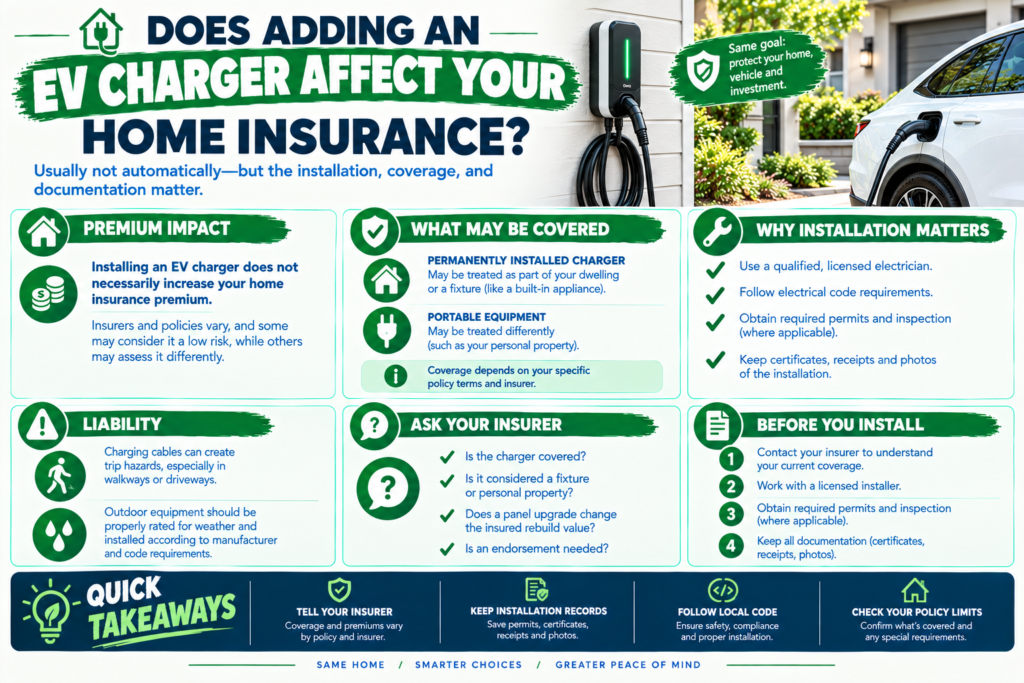
In most cases, installing a home EV charger has little to no direct effect on your homeowner’s insurance premium. However, it’s still worth notifying your insurer, since a properly permitted and professionally installed charger can actually support a smoother claims process if something ever goes wrong — while unpermitted or DIY electrical work can create real complications during a claim, regardless of whether the charger itself was the cause.
Why Insurers Generally Don’t Treat This as High-Risk
A correctly installed Level 2 charger, done by a licensed electrician with a permit and inspection, is treated by most insurers similarly to other standard home electrical upgrades — like adding a hot tub circuit or upgrading a kitchen for an electric range. It’s not inherently viewed as a higher-risk addition the way something like a wood-burning stove or a trampoline might be, since it’s a static, professionally installed electrical circuit rather than an activity-based risk.
Why You Should Still Tell Your Insurer
Even though a premium increase is unlikely for most standard installations, notifying your insurer is worth doing for a few practical reasons:
1. Accurate Coverage of Your Home’s Systems
Your policy is based on your home’s overall electrical system and its insured value. A significant addition — including a new dedicated high-amperage circuit and possibly a panel upgrade — is technically a change to your home’s systems that your insurer’s records should reflect.
2. Smoother Claims If Something Goes Wrong
If your home ever experiences an electrical fire or related damage, having documented, permitted, professionally installed electrical work (including your EV charger) makes it far easier to demonstrate the work met code, rather than having your insurer discover an undocumented modification during a claim investigation.
3. Some Insurers Actually Offer Incentives
A small but growing number of insurers offer discounts or favorable terms for homes with EV charging equipment or other green-home upgrades, reflecting insurer interest in supporting EV adoption. This varies significantly by provider, so it’s worth asking directly rather than assuming none exist.
What Actually Creates Insurance Risk
The charger itself, when properly installed, isn’t the primary insurance concern. These related factors are what actually matter:
Unpermitted Electrical Work
This is the single biggest risk factor, and it’s not specific to EV chargers — any unpermitted electrical modification can complicate a claim if it’s later linked to damage, since insurers can argue the work wasn’t done to code even if it may have been done safely. See our guide on whether you need a permit to install an EV charger for why skipping this step is a real risk regardless of insurance.
DIY Electrical Work
Similarly, if you attempted to install the circuit yourself rather than using a licensed electrician, and something goes wrong, this can be used to deny or reduce a claim. See our guide on whether you can install an EV charger yourself for why this isn’t a place to cut costs.
Using Uncertified Equipment
A charger without proper UL or ETL safety certification introduces genuine risk that a certified product doesn’t — see our guide on EV charger safety certifications to look for before purchasing any charger, regardless of brand or price.
What to Tell Your Insurer
When you notify your insurer about your new charger, it’s worth providing:
- Confirmation that the work was done by a licensed electrician
- Confirmation that a permit was pulled and the installation passed inspection
- The charger’s brand/model and its safety certification status
- Whether a panel upgrade was part of the installation
This documentation supports both accurate coverage and a smoother claims process if it’s ever needed.
Does This Apply to Renters and Condo Owners Too?
If you’re a renter or condo owner who installed a charger with landlord or HOA approval, it’s worth confirming how this is reflected in both the property owner’s insurance and your own renter’s or personal property insurance, since responsibility for the electrical work and equipment can be split differently than in a single-family, owner-occupied home. See our guide on the best EV charger for multi-family homes and apartments for more on navigating approval and installation in these situations.
Worked Example: A Documentation Checklist With Numbers
If you ever need to file a claim, the questions are usually whether the work was permitted and whether the equipment matched the circuit. For a typical installation, your records should show values like these:
| Record | Example value | Why it matters |
|---|---|---|
| Charger rating and setting | 48 A max, set to 40 A | Setting must be ≤ 80% of breaker |
| Breaker | 50 A, 2-pole | 40 ÷ 0.8 = 50 A ✔ |
| Safety listing | UL / ETL / CSA mark on the unit | Shows the product was tested by a recognized lab |
| Permit number and final inspection date | From your building department | Proves the work met local code |
| Electrician’s license number and invoice | On the invoice | Shows licensed installation |
A charger set to 48 A on that same 50 A breaker would draw 120% of the continuous limit — exactly the kind of mismatch an adjuster or inspector would flag.
Figures in this example are illustrative and rounded; your rates, vehicle and installation will differ.
Sources and Further Reading
- U.S. DOE Alternative Fuels Data Center — Charging Plug-In Electric Vehicles at Home
- NFPA 70, National Electrical Code (Article 625 covers EV charging equipment)
- U.S. Consumer Product Safety Commission — Electrical Safety
Last reviewed: October 2026.
Key Takeaways
- Installing a properly permitted, professionally installed home EV charger typically has little to no direct effect on your insurance premium.
- Notifying your insurer is still worthwhile for accurate coverage records and a smoother claims process if something ever happens.
- Unpermitted work, DIY electrical installation, and uncertified equipment are the real risk factors — not the charger itself when done correctly.
- Some insurers offer discounts for EV charging or green-home upgrades, which is worth asking about directly.
Frequently Asked Questions
Will my premium go up if I tell my insurer about my new charger? In most cases, no meaningful increase occurs for a standard, properly installed Level 2 charger — but confirm directly with your specific insurer, since policies and underwriting practices vary.
What happens if I don’t tell my insurer and never file a claim? Nothing directly — but if you ever do need to file a claim related to your home’s electrical system, having accurate records on file generally works in your favor rather than discovering an undisclosed modification during the claims process.
Does adding an EV charger affect my auto insurance too? Generally no — home charger installation is a property matter for your homeowner’s policy, separate from your vehicle’s auto insurance coverage.