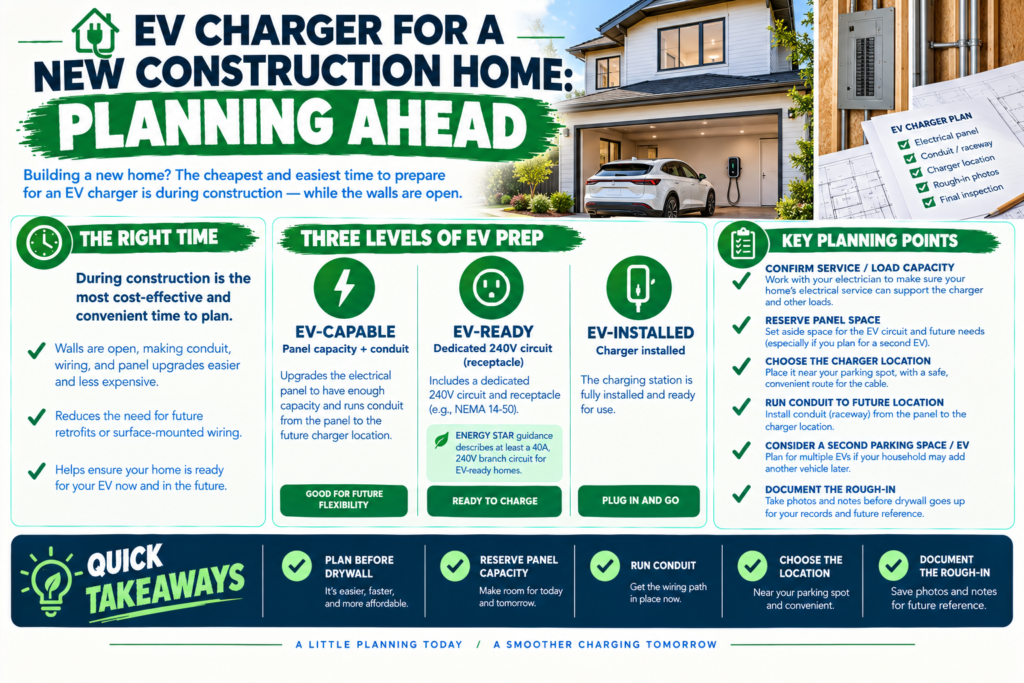
If you’re building a new home, this is one of the easiest and most cost-effective EV charging decisions you’ll ever make — because the incremental cost of planning for it now is a fraction of what a retrofit costs later. Here’s exactly what to ask your builder or electrician for.
Quick Answer
During new construction, ask your builder to install “EV-ready” wiring: a dedicated conduit and either a pre-wired 240V circuit or an empty conduit run from your electrical panel to your garage or driveway parking area, sized for at least a 50-amp circuit even if you don’t install the charger itself right away. This typically costs a few hundred dollars during construction, compared to potentially $1,500-$4,000+ for the same work as a retrofit after walls, driveways, and finishes are already in place.
Why This Is So Much Cheaper During Construction
Retrofitting a home for EV charging after the fact often means:
- Opening finished walls or ceilings to run new wiring
- Trenching through an already-completed driveway or landscaping for a detached garage
- Potentially discovering the panel doesn’t have capacity, requiring a separate upgrade project
During new construction, none of these obstacles exist yet. The electrician is already running wiring through open walls, the driveway hasn’t been poured, and the panel is being sized from scratch — adding a dedicated EV circuit or conduit at this stage is a marginal addition to work that’s happening anyway, not a standalone project.
What to Actually Request: “EV-Ready” vs. “EV-Installed”
There are two levels of preparation worth understanding:
EV-Ready (Conduit Only)
An empty conduit is run from your panel location to your garage or driveway parking area, with a pull string left inside for future wire installation. No wire, outlet, or charger is installed yet — this defers the cost of the actual circuit and charger until you’re ready, while eliminating the most expensive part of a future retrofit (opening walls or trenching).
EV-Installed (Full Circuit)
A complete dedicated circuit is installed, typically terminating in either a NEMA 14-50 outlet or a hardwired connection point, sized for your anticipated amperage. This costs more upfront than the conduit-only option but means you’re ready to simply install a charger with no additional electrical work needed.
For most new construction budgets, even the conduit-only option is worth the modest additional cost, since it preserves the option at a fraction of future retrofit cost.
Panel Sizing Considerations for New Construction
Since you’re sizing your electrical panel from scratch, it’s far easier to plan for EV charging capacity now than to discover a shortfall later:
- Request a 200-amp panel as a baseline for most new homes, which comfortably accommodates a Level 2 EV charger alongside typical household electrical loads
- If you’re planning for multiple EVs eventually, or other major future electrical additions (a pool, an addition, solar panels), discuss whether an even higher panel capacity makes sense from the start
- Ask your electrician to include the EV circuit’s continuous load in their overall load calculation for the home, rather than treating it as an afterthought once the rest of the panel sizing is finalized
See our guide on whether you need a new electrical panel for an EV charger for the underlying principles, which apply even more favorably when you’re planning from scratch rather than retrofitting.
Where to Locate the Conduit or Circuit
Work with your builder to identify the most likely long-term parking and charging location:
- Attached garage installations are generally the simplest and most flexible location
- Driveway locations need weatherproof-rated conduit and outlet/connection planning from the start
- Detached garage situations benefit enormously from planning underground conduit during construction, before landscaping and driveways are finished — see our guide on installing an EV charger in a detached garage for what this involves as a retrofit, and how much easier it is to plan during new construction instead
Questions to Ask Your Builder or Electrician
- Can you include an empty conduit run (or full circuit) from the panel to my garage/driveway during rough-in?
- What panel size are you installing, and does it account for future EV charging load?
- Is the conduit sized appropriately for at least a 50-amp circuit, even if I don’t wire it immediately?
- If I want the full circuit installed now rather than just conduit, what’s the cost difference?
- Will this be documented on my home’s electrical plans for future reference?
Does This Affect Your New Home’s Resale Value?
EV-ready or EV-installed wiring is increasingly viewed as a desirable feature by home buyers, particularly in areas with higher EV adoption rates — similar to how a home wired for a whole-house generator or solar panels can be a selling point. Even if you don’t own an EV yet, this small upfront investment can make your home more appealing to future buyers without requiring you to install a charger you don’t currently need.
Worked Example: Planning Capacity for Two EVs
A new home will likely see two EVs over its life. Planning for that during construction, at 240 V:
| Plan | Circuits | Max charging | Panel space | Overnight energy (8 h) |
|---|---|---|---|---|
| One 60 A circuit, one charger | 1 × 60 A | 48 A (11.52 kW) | 2 spaces | ≈92 kWh for one car |
| One 60 A circuit, two power-sharing chargers | 1 × 60 A | 48 A split (24 A each when both charge) | 2 spaces | ≈46 kWh each |
| Two 50 A circuits | 2 × 50 A | 40 A each (9.6 kW) | 4 spaces | ≈77 kWh each |
Even the power-sharing option adds about 46 kWh — roughly 160 miles at 3.5 mi/kWh — to each car overnight. Ask your builder to leave conduit and panel space for the second circuit even if you install only one charger now.
Figures in this example are illustrative and rounded; your rates, vehicle and installation will differ.
Sources and Further Reading
- U.S. DOE Alternative Fuels Data Center — Charging Plug-In Electric Vehicles at Home
- NFPA 70, National Electrical Code (Article 625 covers EV charging equipment)
- U.S. DOE AFDC — State Laws and Incentives
Last reviewed: October 2026.
Key Takeaways
- Planning for EV charging during new construction costs a small fraction of what a retrofit costs after the home is finished.
- “EV-ready” conduit-only preparation is a low-cost way to preserve the option without paying for a full circuit or charger immediately.
- Request appropriate panel sizing (typically 200 amps) that accounts for EV charging load from the start, rather than treating it as an afterthought.
- This upgrade can also be a meaningful, low-cost resale value consideration, even for buyers who don’t yet own an EV.
Frequently Asked Questions
How much does EV-ready conduit typically add to a new construction budget? This varies by builder and home layout, but it’s generally a few hundred dollars when done during construction — a small fraction of the cost of the same work as a later retrofit, since it avoids opening finished walls or trenching a completed driveway.
Should I install the full circuit now even if I don’t own an EV yet? This depends on your budget and how confident you are that you’ll want a charger in the near future — at minimum, the conduit-only option is worth strongly considering, since it defers the bigger cost decision without losing the ability to add it easily later.
Does new construction wiring guarantee I won’t need a panel upgrade later? Not automatically — you still need to ensure the panel itself is sized appropriately for EV charging alongside your home’s other loads, which is why discussing this specifically with your electrician during the panel sizing phase matters, rather than assuming any new panel automatically has room.

