Introduction
Many new electric vehicle owners wonder if they can use a household dryer outlet to charge their EV. The idea is attractive: a ready-made 240 volt outlet in a garage seems perfect for Level 2 charging. But electrical safety, charging speed, and building codes complicate the answer. This guide explains what a dryer outlet is, when it can be used for EV charging, the risks of adapters or improvised setups, and the smart steps to take to charge safely and legally.
Understanding Dryer Outlets and EV Charging Basics
Dryer outlets are typically 240 volt circuits wired for electric clothes dryers. Common types include NEMA 14-30 and older NEMA 10-30 receptacles. They are usually on a 30 amp breaker and wired with either three or four conductors depending on age and local code.
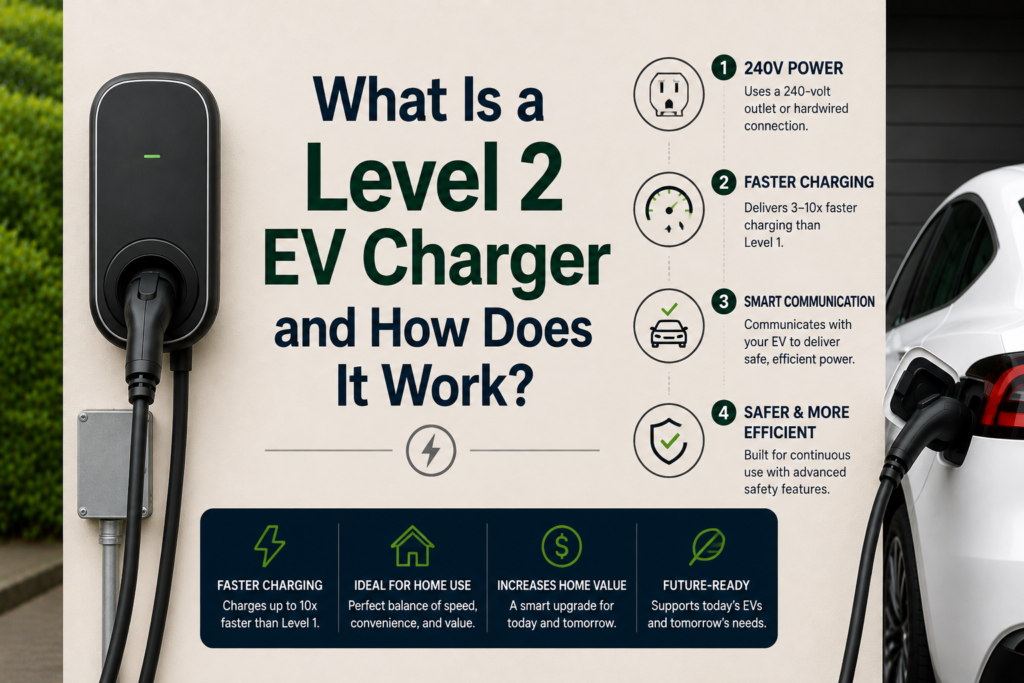
EV charging levels are generally divided into Level 1 and Level 2. Level 1 uses a standard 120 volt outlet and is slow. Level 2 uses 240 volt circuits and is much faster. Most home Level 2 EV chargers are designed for 32, 40, or 48 amp service, often using NEMA 14-50 style outlets or a dedicated hardwired circuit.
Key electrical rules to know
- Continuous load sizing: The National Electrical Code treats EV charging as a continuous load, which means circuits must be sized at 125 percent of the continuous current. Practically, this means you should not draw more than 80 percent of the breaker rating for continuous charging.
- Wire gauge and breaker match: The wire size must match the breaker rating. Common wire sizes include 10 AWG for 30 amp circuits and 8 AWG for 40 amp circuits.
- Grounding and neutral: Modern EV chargers require a proper ground and appropriate wiring. Older 3-prong dryer outlets that lack a separate ground are not acceptable for most EV charging equipment.
Can You Charge an EV From a Dryer Outlet?
The short answer is: sometimes, but with important caveats.
If you have a modern four-prong 240V dryer outlet such as a NEMA 14-30 in good condition and your EV or portable EVSE supports the outlet amperage, you can physically charge from it. However, because most dryer circuits are 30 amp breakers, the continuous charging current must be limited to 80 percent of that breaker, which equals about 24 amps of continuous current. At 240 volts, that yields roughly 5.8 kilowatts of charging power, which is slower than many dedicated Level 2 chargers but still useful.
When it might work
- If your EVSE supports adjustable current and can be set to 24 amps or lower.
- If the outlet is a properly wired four-prong receptacle with a solid ground and correct wire gauge.
- If you only need a temporary or slow overnight charge and the manufacturer permits the arrangement.
When it is not appropriate
- If the outlet is an older three-prong NEMA 10-30 lacking a ground. That configuration is unsafe for EV charging and generally not code-compliant.
- If the EVSE you plan to use is rated higher than the dryer circuit and cannot be limited to the circuit capacity.
- If the outlet wiring condition or breaker integrity is unknown or questionable.
- If local code or your utility requires a dedicated circuit for EV charging without shared loads.
Risks of Using Adapters or Improvised Solutions
Using adapters to plug an EVSE into a dryer outlet may seem convenient, but there are risks:
- Overheating and fire risk: Mismatched connectors, poor contacts, or improper adapters can overheat under continuous load.
- Code and insurance issues: Improvised connections can violate electrical code and potentially affect insurance coverage if an incident occurs.
- Vehicle warranty implications: Using non-approved charging configurations could complicate warranty claims in some cases.
Best Practices and Steps to Take
To charge safely and reliably, follow these steps:
- Inspect the outlet: Verify the receptacle type, breaker rating, wire gauge, and presence of a separate ground. If in doubt, call an electrician.
- Use a compatible EVSE: Choose a portable EVSE that can be set to the outlet capacity or use a charger designed for the specific receptacle type.
- Avoid adapters if possible: Instead of adapters, consider installing a dedicated EV outlet or a hardwired Level 2 charger on the proper circuit.
- Follow continuous load rules: Ensure charging current does not exceed 80 percent of the breaker rating for continuous loads.
- Obtain permits and inspections: If you install a new circuit or upgrade an outlet, get proper permits and inspections to meet local code and protect safety and insurance coverage.
Installing a Dedicated EV Circuit
For most EV owners who charge regularly, the best option is a dedicated Level 2 circuit sized for the charger and vehicle. A typical recommendation:
- Install a 40 amp or 50 amp circuit depending on desired charging speed and vehicle capability.
- Use appropriate wire gauge, breaker, and receptacle or hardwiring for a wallbox charger.
- Hire a licensed electrician and obtain any required permits and inspections.
Worked Example: What a Dryer Circuit Can Deliver
A 30 A, 240 V dryer circuit allows at most 30 × 0.8 = 24 A of continuous charging. Power = 240 V × 24 A = 5,760 W, or 5.76 kW. Assuming 3.5 miles per kWh:
| Circuit | Max charging current | Power | Range per hour | 8 hours overnight |
|---|---|---|---|---|
| 30 A dryer circuit | 24 A | 5.76 kW | ≈20 miles | ≈46 kWh / ≈161 miles |
| 40 A dedicated circuit | 32 A | 7.68 kW | ≈27 miles | ≈61 kWh / ≈215 miles |
| 50 A dedicated circuit | 40 A | 9.60 kW | ≈34 miles | ≈77 kWh / ≈269 miles |
For a 40-mile daily commute (about 12.7 kWh from the wall with charging losses), even the dryer circuit refills the battery in roughly 2.2 hours. Sharing the circuit with the dryer itself, or setting a charger above 24 A on a 30 A breaker, is not safe — ask an electrician about a listed load-sharing device or a dedicated circuit.
Figures in this example are illustrative and rounded; your vehicle and installation will differ.
Sources and Further Reading
- U.S. DOE Alternative Fuels Data Center — Charging Plug-In Electric Vehicles at Home
- NFPA 70, National Electrical Code (Article 625 covers EV charging equipment)
- U.S. Consumer Product Safety Commission — Electrical Safety
Last reviewed: October 2026.
Conclusion
Can you charge an EV with a dryer outlet? In many cases a modern 240V dryer outlet can be used temporarily or at a limited charging rate if it is properly wired and the charging equipment can be set to the circuit capacity. However, older three-prong dryer outlets, improvised adapters, or unknown wiring conditions create safety, code, and insurance risks. The safest long-term approach is to install a dedicated EV charging circuit or professionally installed Level 2 charger. Always consult a licensed electrician and follow local electrical code to ensure safe, reliable, and legal EV charging.
Need help deciding? If you are unsure about your dryer outlet or which charging setup is best for your vehicle, contact a licensed electrician experienced with EV installations to evaluate your garage and recommend the proper solution.