
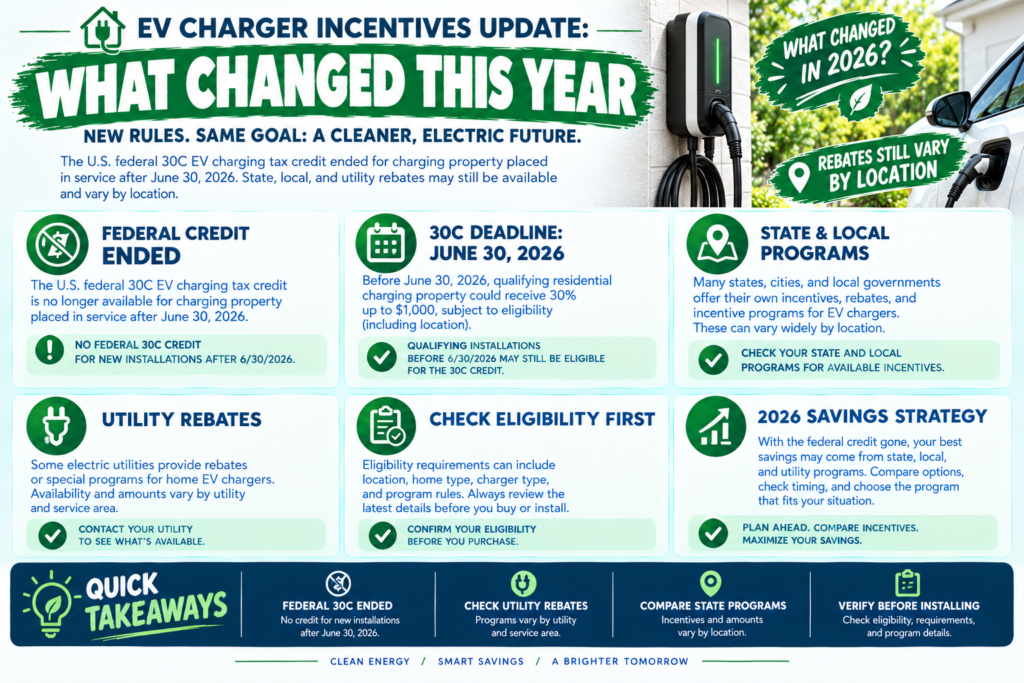
2026 has been the most significant year of change for EV incentives in over a decade. If you’ve been holding off on a home charger installation while waiting to understand the landscape, here’s a clear summary of exactly what changed, when, and what it means for your decision now.
Quick Answer
The federal home EV charger tax credit (Section 30C) expired for equipment placed in service after June 30, 2026, following legislation — the “One Big Beautiful Bill Act,” signed into law in July 2025 — that accelerated its original sunset date. Separately, federal EV purchase tax credits also ended for vehicles acquired after September 30, 2025. With federal incentives largely gone, state, utility, and manufacturer programs now play a much larger role in overall EV and charger savings.
The Big Change: Federal Charger Credit Expired June 30, 2026
While it was active, the Alternative Fuel Vehicle Refueling Property Credit covered 30% of combined equipment and installation costs for a home charger, up to a maximum credit of $1,000 per residential property — so a typical $500 charger plus $800 installation could have generated a credit of roughly $390. This credit was already limited to specific census tracts (generally non-urban or lower-income areas) even before its expiration, so not every homeowner who installed a charger before the deadline necessarily qualified.
If your charger was placed in service on or before June 30, 2026, you may still be able to claim this credit for that tax year using IRS Form 8911 — see our federal tax credit guide for home EV chargers for the full breakdown of how this worked while it was active. Installations completed after that date are no longer eligible federally.
The Related Change: Federal EV Purchase Credits Also Ended
Separately from the charger credit, the well-known federal tax credits for buying a new ($7,500) or used ($4,000) electric vehicle ended for vehicles acquired after September 30, 2025. This is a different program from the home charger credit covered on this site, but the two changes are related and came from the same legislation, so they’re worth understanding together if you’re planning both an EV purchase and a home charging setup.
One narrow exception exists: a vehicle secured under a binding written contract with payment on or before September 30, 2025 may still qualify for the purchase credit even if delivery happened later, since eligibility is generally based on when the vehicle was placed in service relative to the contract date. This is a specific situation worth discussing with a tax professional rather than assuming it applies broadly.
A New Federal Benefit Worth Knowing About
Not everything moved in one direction. The same legislative changes introduced a new federal deduction allowing eligible buyers to deduct up to $10,000 per year in interest paid on a qualifying new vehicle loan, available from 2025 through 2028 for EVs and other vehicles assembled in the U.S. This doesn’t offset charger installation costs directly, but it’s a relevant new consideration if you’re financing an EV purchase alongside your home charging setup.
What This Means for State and Utility Programs
With federal incentives largely off the table, state and utility programs have become the primary lever for reducing EV and charger costs in 2026:
- Some states, like California and New York, maintain their own charger-specific incentives entirely independent of the federal timeline — see our guides on California and New York EV charger incentives for specifics.
- Utility company rebates continue to operate on their own schedules and funding cycles, unaffected by the federal credit’s expiration — our state-specific incentive guides cover major utility programs in each state.
- Some state EV purchase incentives remain active but aren’t universally funded — availability varies significantly, and a few states have programs technically “on the books” without current funding behind them.
- Manufacturer and dealer discounts have reportedly increased in response to the loss of federal purchase credits, particularly on models that lost federal eligibility, which can indirectly make pairing an EV purchase with a home charger installation more affordable overall.
Should You Rush to Install a Charger Now?
If your specific state or utility program has its own deadline or funding cap, timing can still matter — but the federal charger credit’s June 30, 2026 deadline has already passed, so there’s no remaining federal urgency driving an immediate installation decision. Focus instead on:
- Confirming your specific state and utility program’s current status and any funding deadlines
- Getting your installation done properly regardless of incentive timing, since a correctly installed, permitted charger is the more important long-term factor — see our complete guide on home EV charger installation costs
- Checking whether combining a state rebate with a utility program (where both exist) is still possible in your area, since federal-level stacking is no longer part of the equation
Key Takeaways
- The federal home charger tax credit (Section 30C) expired for installations after June 30, 2026, following 2025 legislation that moved up its sunset date.
- Federal EV purchase credits ($7,500 new, $4,000 used) separately ended for vehicles acquired after September 30, 2025.
- A new federal deduction for vehicle loan interest (up to $10,000/year through 2028) partially offsets the loss of purchase credits for financed buyers.
- State and utility programs are now the primary source of EV and charger savings, and vary significantly — always check current program status directly.
Frequently Asked Questions
Is there any chance the federal charger credit comes back? Future legislation could reinstate or replace this credit, but there’s no current program to count on. Base your installation budget on currently available incentives rather than anticipated future changes.
Do these federal changes affect incentives I already claimed in a prior year? No — these changes affect eligibility for equipment placed in service or vehicles acquired after the specific 2025/2026 cutoff dates. Credits properly claimed for qualifying prior-year installations or purchases aren’t retroactively affected.
Where’s the best place to check for the most current incentive information? Official sources — IRS.gov for federal programs, your state energy office for state programs, and your specific utility’s website for utility rebates — are more reliable than general summary articles (including this one) for the most current figures, since programs and funding levels change throughout the year.

