
Meta title (55-60 chars): How to Stack EV Charger Incentives in 2026 Meta description (150-155 chars): How to combine state and utility EV charger incentives in 2026, now that the federal credit has expired, to maximize your total savings. Target keyword: stack ev charger incentives Secondary keywords: combine ev charger rebates, state and utility ev incentives stacking, maximize ev charger savings
“Stacking” incentives — combining more than one program to reduce your total cost — used to mean layering a federal tax credit on top of state and utility rebates. With the federal home charger credit now expired, the stacking strategy has shifted, but it hasn’t disappeared. Here’s how to maximize savings with the incentives still available in 2026.
Quick Answer
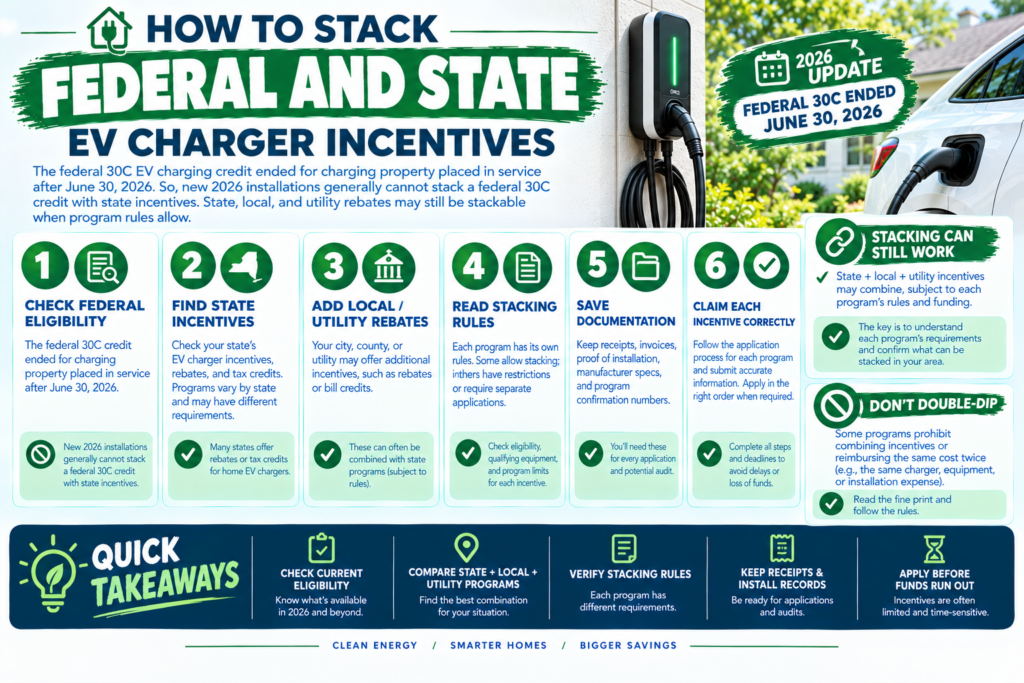
As of 2026, the federal home EV charger tax credit (Section 30C) has expired for installations after June 30, 2026, so stacking now generally means combining a state-level program (where available), a utility company rebate, and sometimes a regional or county-level incentive — rather than adding a federal credit on top. Most of these remaining programs come from different funding sources and are generally combinable, but always confirm each program’s specific stacking rules before assuming they apply together.
Why Stacking Still Matters Even Without the Federal Credit
Losing the federal credit doesn’t mean incentive stacking is no longer worthwhile — it just means the combination looks different than it did before mid-2026. Depending on where you live, you may still be able to combine:
- A state-level tax credit or rebate (where your state offers one, such as New York’s Form IT-253 credit)
- A utility company rebate (such as those offered by PG&E, SCE, Austin Energy, or NYSEG)
- A regional or county-level program layered on top of state and utility incentives, where available
- Manufacturer or retailer promotions on the charger equipment itself, which are separate from government incentive programs entirely
Combining even two of these can meaningfully reduce your total installation cost, even without the federal piece that used to be part of the equation.
Step 1: Confirm What’s Available Federally (For Past Installations Only)
If your charger was installed and placed in service on or before June 30, 2026, you may still be eligible to claim the federal Alternative Fuel Vehicle Refueling Property Credit for that tax year — worth up to 30% of combined equipment and installation costs, capped at $1,000, and subject to the program’s census tract eligibility requirement. See our federal tax credit guide for home EV chargers for the full details. For any installation after that date, skip this step entirely and focus on state and utility programs instead.
Step 2: Check Your State’s Program
Not every state offers its own charger-specific incentive, but some do, and they operate entirely independently of the federal timeline:
- New York offers a state income tax credit (Form IT-253) for qualified home charging equipment
- California doesn’t have a single statewide charger rebate, but offers extensive utility-level programs instead
- Texas similarly has no statewide charger rebate, relying entirely on utility programs
Check our state-specific incentive guides for California, Texas, and New York for details, and search for your own state’s energy office if you’re located elsewhere, since program availability changes and new state programs can be introduced.
Step 3: Check Your Utility Company’s Rebate
Your utility rebate is often the most reliable, ongoing source of savings, since these programs run on their own budgets and timelines independent of federal or even state-level changes. Confirm:
- Whether your specific utility currently has an active residential charger rebate
- Whether there’s an income-qualified tier offering a higher rebate amount
- Whether the rebate requires a specific charger model or certification (such as ENERGY STAR) from an approved list
- Whether you need pre-approval before installation, or can apply afterward with receipts
Step 4: Look for Regional or County-Level Programs
In some areas, additional funding exists at a regional level, layered on top of state and utility programs — California’s CALeVIP initiative is one example, offering region-specific funding rounds that can be combined with a utility rebate. These programs tend to be less publicized than statewide or utility programs, so a direct search for your specific county or region alongside “EV charger rebate” is worth doing.
Step 5: Check for Manufacturer or Retailer Promotions
Separately from government incentive programs, charger manufacturers and major retailers occasionally offer their own discounts or bundle promotions, particularly around major shopping periods. These aren’t official “incentives” in the same sense, but they stack on top of any government program you qualify for, since they reduce your equipment cost directly rather than through a rebate or credit process. See our guide on the best EV charger deals for Black Friday and Cyber Monday for seasonal opportunities.
A Realistic Stacking Example (2026)
Consider a homeowner in a California utility territory with an income-qualifying panel upgrade need:
- SCE’s Charge Ready Home program covers a substantial portion of panel upgrade costs for income-qualified customers
- The homeowner separately purchases a charger during a manufacturer promotion, reducing the equipment cost
- No federal credit applies, since the installation occurs after June 30, 2026
Compare this to a New York homeowner:
- A utility rebate (NYSEG or PSEG Long Island, depending on location) covers part of the equipment cost
- The state tax credit (Form IT-253) is claimed separately on their New York State tax return for the qualifying equipment cost
- Again, no federal credit applies for a 2026 installation completed after the deadline
Both examples show that meaningful stacking is still very possible — it just requires checking two or three specific programs rather than assuming a federal credit is automatically part of the mix.
Common Stacking Mistakes to Avoid
- Assuming the federal credit still applies to a 2026 installation completed after June 30 — it doesn’t, regardless of what older articles or outdated calculators might suggest
- Missing a state-level program because it’s less well-known than utility rebates — always check your specific state, not just your utility
- Not confirming equipment eligibility requirements before purchasing, since some programs require ENERGY STAR certification or a specific approved-product list
- Missing pre-approval requirements, since some programs require enrollment before installation rather than allowing an after-the-fact application
Key Takeaways
- Incentive stacking in 2026 generally means combining state, utility, and sometimes regional programs — the federal charger credit is no longer part of the equation for new installations.
- State-level programs vary significantly; some states (like New York) have their own tax credit, while others (like California and Texas) rely entirely on utility rebates.
- Utility rebates remain the most consistent source of ongoing savings, operating independently of federal policy changes.
- Always confirm each program’s specific stacking rules and eligibility requirements directly, since combinability isn’t universal across every possible pairing.
Frequently Asked Questions
Can I still combine a utility rebate with a state tax credit? In most cases yes, since these typically come from different funding sources with independent eligibility rules — but confirm with your specific state and utility, since individual program terms can vary.
Is there any harm in applying to multiple programs at once? Generally no, as long as you’re honest and accurate in each application and meet each program’s individual requirements — just be organized about documentation, since you’ll likely need separate proof of purchase and installation for each program.
Should I wait for a new federal incentive before installing my charger? There’s no indication of when or whether a new federal charger incentive might be introduced, so it’s generally more practical to move forward based on currently available state and utility programs rather than delaying indefinitely for uncertain future federal action.

