Warranty terms vary more between EV charger brands than many buyers expect, and the fine print matters — particularly around installation requirements and what counts as normal wear versus a covered defect. Here’s what to actually look for before you buy.
Quick Answer
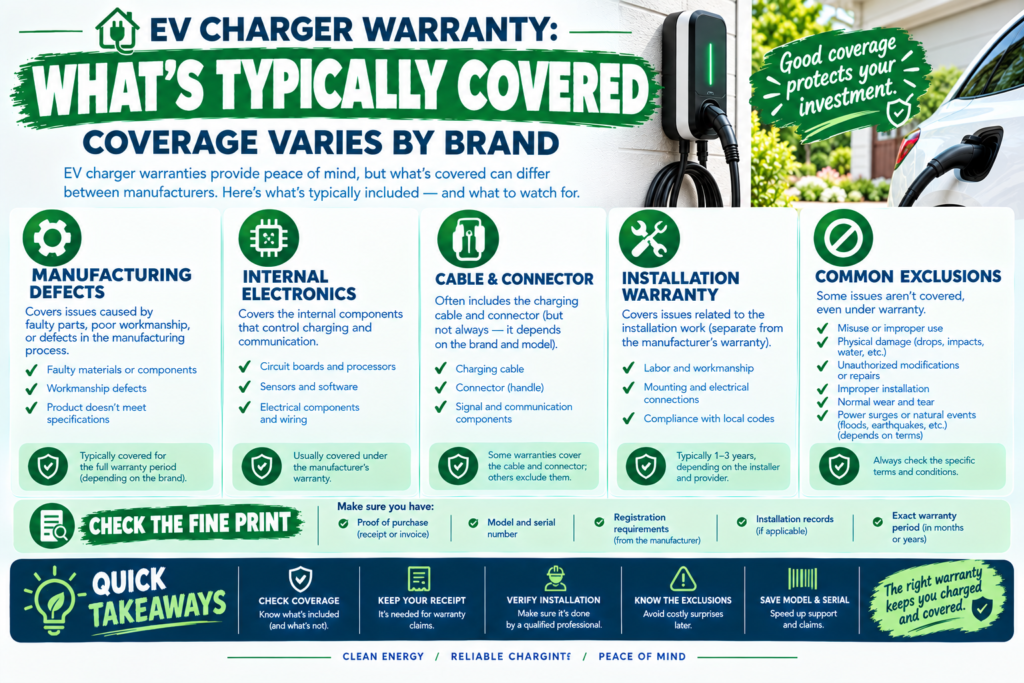
Most home Level 2 EV chargers come with a manufacturer warranty of 2 to 5 years, covering manufacturing defects in materials and workmanship under normal residential use. Warranties typically do not cover installation errors, damage from misuse, weather damage to indoor-rated units installed outdoors, or normal wear on the charging cable. Many manufacturers also require professional installation to keep the warranty valid — a detail worth confirming before you install.
What’s Typically Covered
- Manufacturing defects in the charger’s internal electronics, housing, and components
- Premature failure under normal, intended use consistent with the product’s specifications
- Software or firmware issues originating from the manufacturer, on smart/connected models
- Workmanship defects, such as a faulty internal connection present from manufacturing rather than caused by external damage
Coverage typically includes either repair or replacement at the manufacturer’s discretion, and may include shipping costs for a replacement unit, though this varies by brand.
What’s Typically NOT Covered
- Installation errors, including incorrect wiring, improper circuit sizing, or installation by an unlicensed or unqualified electrician
- Physical damage from accidents, vehicle impact, or improper handling
- Weather damage to an indoor-rated unit installed outdoors, or outdoor damage exceeding the unit’s actual rated protection level
- Normal wear and tear on the charging cable and connector from years of regular use, which several manufacturers explicitly treat as a wear item rather than a warranty-covered component
- Damage from unauthorized modifications or attempted DIY repairs to the unit itself
- Issues caused by an inadequate or unstable power supply, such as a home electrical system with pre-existing issues unrelated to the charger
Does Installation Method Affect Your Warranty?
This is one of the most commonly overlooked warranty details: several manufacturers explicitly require installation by a licensed electrician to keep the warranty valid, and some request documentation (a permit, an invoice from a licensed contractor) if a warranty claim is filed. This is a strong practical reason — beyond safety and code compliance — to avoid DIY electrical work when installing your charger, covered in more detail in our guide on whether you can install an EV charger yourself.
Before installation, it’s worth reading your specific charger’s warranty terms for any installation-related requirements, since these vary by manufacturer and aren’t always prominently advertised.
Typical Warranty Length by Coverage Tier
| Coverage type | Typical length |
|---|---|
| Basic manufacturer warranty | 2 – 3 years |
| Extended/premium brand warranty | 3 – 5 years |
| Cable/connector specific coverage | Often shorter, or treated as a wear item |
| Optional extended warranty (if offered) | Varies, purchased separately |
Warranty length varies by brand and sometimes by specific model within the same manufacturer’s lineup, so confirm the exact term for the specific charger you’re considering rather than assuming a brand-wide standard.
How to File a Warranty Claim
- Locate your proof of purchase and, if applicable, your installation documentation (permit, electrician invoice).
- Contact the manufacturer directly rather than the retailer, in most cases, since EV charger warranties are typically manufacturer-backed rather than retailer-backed.
- Describe the specific issue, including any error codes, troubleshooting steps already attempted, and when the issue started.
- Follow the manufacturer’s diagnostic process, which may include remote troubleshooting steps before a replacement or repair is authorized.
- Keep records of all communication and any reference or case numbers provided during the claims process.
Questions to Ask Before You Buy
- Does the warranty require professional installation, and if so, what documentation is needed to prove it?
- Is the charging cable covered under the same warranty term as the main unit, or treated separately?
- Does the warranty cover shipping costs for a replacement unit?
- Is the warranty transferable if you sell your home with the charger installed?
- What’s the manufacturer’s typical response and resolution time for a claim?
Extended Warranties: Worth It or Not?
Some retailers or manufacturers offer optional extended warranty coverage beyond the standard term. Whether this is worth the added cost depends on:
- How long you plan to keep the charger and stay in your current home
- The base manufacturer warranty length already included
- The charger’s real-world reliability reputation, which is generally strong across the established brands covered in our full guide to the best home EV chargers of 2026
For most buyers choosing a well-reviewed, certified charger from an established brand, an extended warranty is a personal risk-tolerance decision rather a necessity, given how uncommon early failure tends to be with properly installed equipment.
Key Takeaways
- Most home EV chargers carry a 2-5 year manufacturer warranty covering defects in materials and workmanship, not installation errors or misuse.
- Several manufacturers require licensed electrician installation to keep the warranty valid — confirm this before installing.
- The charging cable is often treated as a wear item with different or shorter coverage than the main charger unit.
- Ask about shipping costs, transferability, and documentation requirements before you buy, not after you need to file a claim.
Frequently Asked Questions
Does my electrician’s work come with its own separate warranty? Often yes — many licensed electricians offer their own labor warranty, separate from the charger manufacturer’s product warranty, covering issues specifically related to their installation work. Ask about this directly when getting quotes.
Will a warranty claim be denied if I didn’t get a permit for installation? It’s possible, particularly if the manufacturer specifically requires professional, code-compliant installation and asks for documentation during a claim — another reason permitted, professional installation matters beyond just safety and legal compliance.
Can I transfer my charger’s warranty if I sell my house? This varies by manufacturer — some warranties are tied to the original purchaser, while others transfer with the equipment. Check your specific charger’s warranty terms, and consider mentioning this to potential buyers if you’re selling a home with an installed charger.