
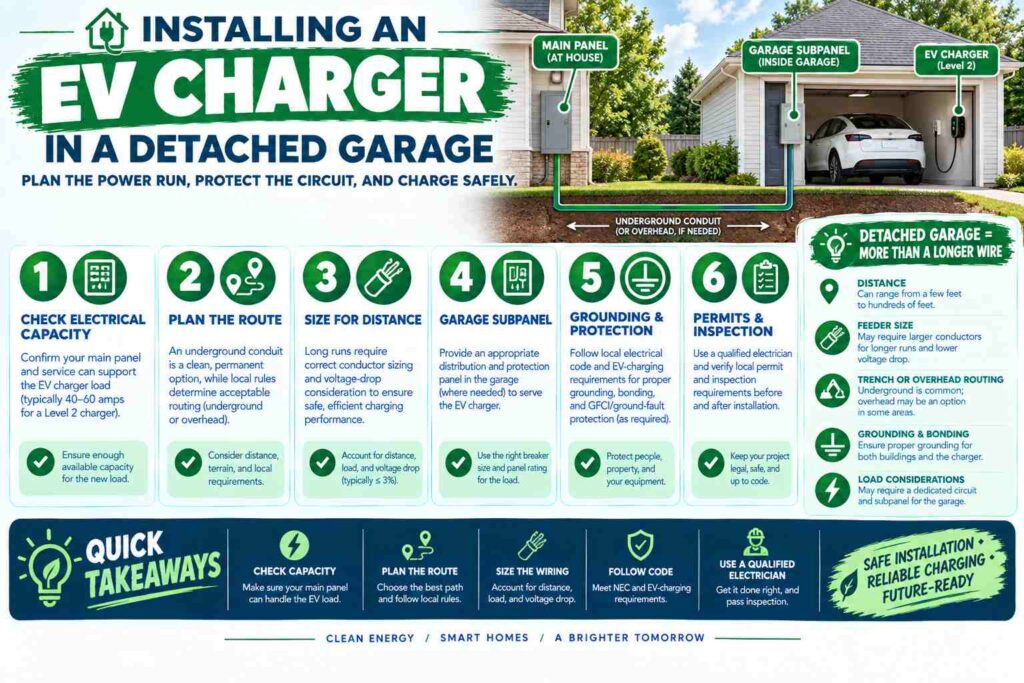
A detached garage adds a genuine layer of complexity to EV charger installation that an attached garage doesn’t have: getting power from your main panel to a separate structure, often underground. It’s very doable, but it’s worth understanding what’s actually involved before you get a quote. Here’s the full picture.
Quick Answer
Installing an EV charger in a detached garage typically requires either a long underground wire run from your main panel or, more commonly for higher-amperage installations, a dedicated sub-panel installed in the garage itself, fed by a single larger circuit from the house. This adds cost compared to an attached-garage installation — often $1,000-$3,000+ more — primarily due to trenching, conduit, and additional electrical work, but it’s a standard, well-understood type of project for a licensed electrician.
Why Detached Garages Are More Complex
An attached garage typically shares a wall with your home’s electrical panel or is at least within a straightforward, direct wiring path. A detached garage requires power to cross open ground (or sometimes overhead) to reach a completely separate structure, which introduces:
- Underground trenching and conduit requirements, governed by specific code provisions for buried electrical wiring
- Longer wire runs, which increase voltage drop concerns and often require thicker wire gauge — see our guide on how far an EV charger can be from the electrical panel for the underlying principles
- The question of a sub-panel versus one long dedicated circuit, which becomes more relevant at greater distances
- Additional permit considerations specific to underground work and, in some jurisdictions, a “detached structure” electrical permit category
Sub-Panel vs. Single Long Circuit: Which Makes Sense?
When a Single Circuit Works
For shorter distances (roughly under 100 feet) with only the charger as the electrical load in the detached garage, one appropriately sized dedicated circuit run underground from the main panel is often the simplest, most cost-effective approach.
When a Sub-Panel Makes More Sense
If your detached garage is further away, or if you want or already have other electrical needs there (lighting, outlets, tools, a workshop), installing a small sub-panel fed by one larger circuit from the main panel is often more practical. This lets you add multiple circuits within the garage itself without running separate long wires from the house for each one — the EV charger becomes just one of potentially several circuits fed from that sub-panel.
A licensed electrician can help you weigh this based on your garage’s total electrical needs, not just the charger alone, since a sub-panel installed now can save significant cost if you add other electrical needs to the garage later.
Underground Wiring Requirements
Running power underground to a detached garage involves specific code requirements:
- Approved underground-rated conduit or direct-burial-rated cable, depending on the method used
- Minimum burial depth, which varies based on the conduit type and whether the wiring is under a driveway, lawn, or other surface — driveways generally require deeper burial due to the load above
- Warning tape or markers buried above the conduit in some jurisdictions, to alert future digging (such as landscaping work) to the buried electrical line
- A disconnect and grounding setup at the detached structure, which is a specific code requirement for any structure with its own sub-panel
Permit and Inspection Considerations
Detached garage electrical work typically requires the same permit and inspection process as any other EV charger installation, covered in our guide on whether you need a permit to install an EV charger, but may involve an additional inspection step specifically for the underground portion of the work before it’s covered by soil or a driveway surface. Don’t backfill a trench before this inspection is complete, since inspectors typically need to visually verify the conduit and depth before it’s buried.
Cost Considerations Specific to Detached Garages
| Cost factor | Why it adds cost |
|---|---|
| Trenching | Labor and equipment to dig a trench of appropriate length and depth |
| Underground-rated conduit/cable | Different, sometimes more expensive materials than standard indoor wiring |
| Additional permit/inspection steps | Some jurisdictions charge separately for underground or detached-structure work |
| Potential sub-panel | Added equipment and labor cost if this approach is chosen over a single circuit |
| Landscaping/surface restoration | Repairing lawn, pavers, or driveway surface disturbed during trenching |
Overall, expect a detached garage installation to run meaningfully higher than a comparable attached-garage project — see our complete guide on home EV charger installation costs for baseline pricing to compare against.
Alternatives Worth Considering
- Overhead wiring (rather than underground) is sometimes a lower-cost alternative depending on the layout between your house and garage, though it may face aesthetic or code restrictions in some areas — ask your electrician if this is a realistic option for your property.
- A portable Level 2 charger used with an existing appropriate outlet, if one already exists in the detached garage for another purpose, can avoid new wiring work entirely, though this depends on having a correctly rated outlet already in place — see our guide to the best portable Level 2 EV chargers.
Key Takeaways
- Detached garage installations typically cost $1,000-$3,000+ more than attached garage installations, mainly due to trenching and underground wiring requirements.
- A sub-panel often makes more sense than a single long circuit if the garage has, or might have, other electrical needs beyond just the charger.
- Underground wiring has specific code requirements for depth, conduit type, and inspection timing — don’t backfill before inspection.
- Overhead wiring or reusing an existing appropriate outlet are worth asking about as potential lower-cost alternatives, depending on your property’s layout.
Frequently Asked Questions
How much does trenching typically add to the cost? This varies significantly by distance, soil conditions, and whether the trench crosses a driveway or other hardscaping, but it’s often one of the largest single cost additions in a detached garage installation — get a specific quote from your electrician rather than relying on a general estimate.
Can I dig the trench myself to save money? This is one of the more realistic DIY tasks in the process, since digging itself isn’t specialized electrical work — but confirm the required depth and any utility locate requirements (calling 811 before digging) beforehand, and have the electrician handle the actual wiring and conduit installation.
Do I need a separate permit for a detached garage sub-panel? Often yes, since adding a sub-panel to a structure is typically treated as its own scope of electrical work requiring inspection — confirm with your local permitting office or ask your electrician to handle this as part of their standard process.

