The price gap between a budget Level 2 charger and a premium one can be $300 or more — often for equipment that delivers the same core charging speed. So what does that extra money actually buy, and when does it genuinely matter? Here’s a clear-eyed breakdown.
Quick Answer
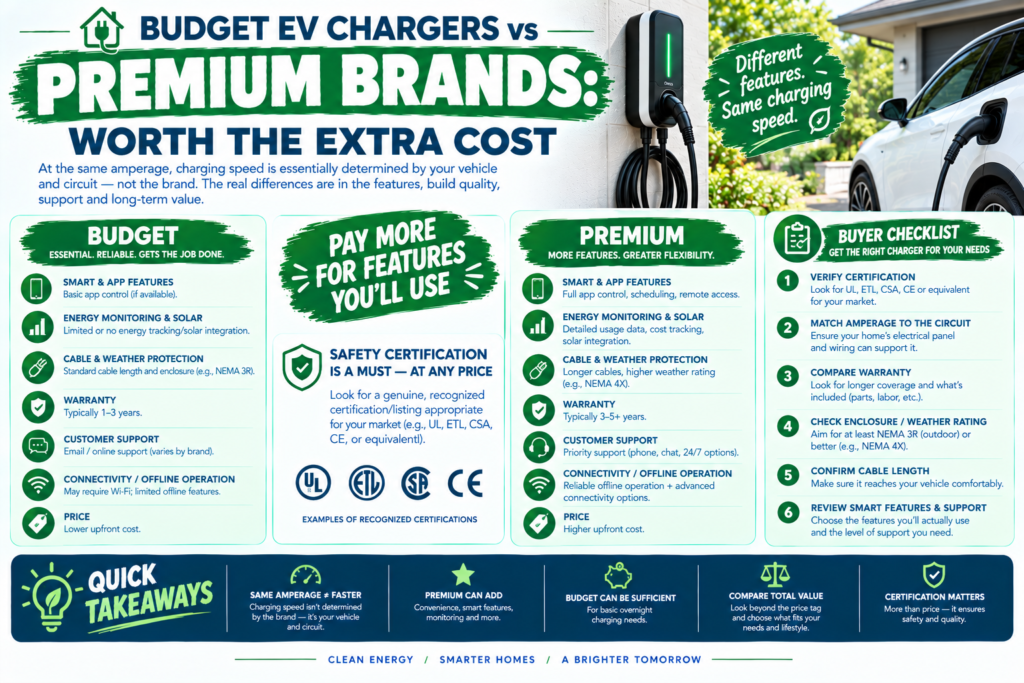
The price difference between budget and premium EV chargers rarely reflects a difference in core charging safety or reliability — both tiers, from reputable brands, must meet the same UL or ETL safety certification. The premium comes from smart features (app control, scheduling, energy monitoring), build refinement, and sometimes higher maximum amperage. For buyers who don’t need those specific features, a budget charger is a fully legitimate choice, not a compromise on safety.
What “Budget” Actually Means Here
In this comparison, “budget” refers to well-reviewed, properly certified chargers in the $270-$400 range (like the Grizzl-E Classic), not unbranded, uncertified units sold cheaply through third-party marketplace listings with no verifiable safety testing. That distinction matters — see our guide on EV charger safety certifications to look for before considering any charger regardless of price, since certification, not price tier, is the non-negotiable factor.
What Premium Pricing Actually Buys
1. Smart Features
This is the single biggest driver of price difference. App-based scheduling, energy monitoring, remote start/stop, and firmware updates are the primary features you’re paying for as you move up in price — see our WiFi-enabled vs. basic chargers comparison for a full breakdown of what these features do and when they’re worth it.
2. Higher Maximum Amperage
Some premium chargers offer a wider adjustable amperage range (up to 50A) compared to budget models often capped around 40A. This matters only if your vehicle and electrical panel can actually use the higher amperage — see our guide on how many amps you need for a home EV charger before assuming more is better for your situation.
3. Build Materials and Design Refinement
Premium chargers often use more refined enclosures, sometimes smaller physical footprints, and design details that budget chargers skip in favor of a simpler, more utilitarian housing. This doesn’t necessarily mean budget chargers are less durable — some, like Grizzl-E, are specifically known for rugged build quality despite lower prices — but the overall fit and finish tends to be more polished on premium models.
4. Ecosystem Integration
Some premium brands (like ChargePoint) tie your home charger into a broader public charging network account, or (like Wallbox) offer unique features like power sharing between multiple units. These are genuine value-adds for specific situations, not general quality improvements.
5. Brand Reputation and Support Infrastructure
Larger, more established brands often have more extensive customer support infrastructure and a longer track record, which can matter if you value that reassurance, even though it doesn’t necessarily translate to a functionally better charging experience for typical use.
What Doesn’t Change Between Budget and Premium
- Core charging safety, provided both are properly certified (UL Listed or ETL Certified)
- Basic charging reliability for the amperage the unit is rated for
- Compatibility with your vehicle, since virtually all use the standard J1772 connector
- Actual electricity delivered, since charging speed depends on amperage and your vehicle’s onboard charger, not brand prestige
When Budget Makes Complete Sense
- You don’t need or want app-based scheduling or energy monitoring
- Your utility doesn’t offer time-of-use electricity rates, removing the main financial case for smart scheduling
- You want to minimize upfront cost, such as for a rental property or secondary installation
- You value simplicity and fewer potential points of failure (no WiFi dependency, no app to troubleshoot)
When Premium Is Worth the Extra Cost
- Your utility offers time-of-use rates where scheduling can generate real savings over time
- You want detailed energy usage tracking for budgeting purposes
- You need the wider amperage range for a larger EV, higher daily mileage, or future-proofing
- You have or plan to add a second EV and want power-sharing capability
- You specifically value the polish of a more refined app and hardware experience
A Practical Way to Decide
Ask yourself: “If this charger had no app and no WiFi, would I still be satisfied with it?”
If yes, a budget charger likely serves you just as well as a premium one, and the extra cost of a premium model would be paying for features you won’t meaningfully use. If no — if scheduling, monitoring, or higher amperage genuinely matter to your situation — the premium price is buying something real, not just a brand name.
Key Takeaways
- The price gap between budget and premium chargers reflects features (smart connectivity, amperage range, design refinement) — not a difference in core safety or basic charging reliability.
- Both tiers require the same UL or ETL safety certification from reputable brands; certification, not price, is the non-negotiable factor.
- Budget chargers are a fully legitimate choice for buyers who don’t need smart features, not an inherent compromise.
- Premium pricing is worth it specifically when time-of-use electricity rates, higher amperage needs, or multi-EV power sharing genuinely apply to your situation.
Frequently Asked Questions
Are premium chargers more reliable long-term than budget ones? Not necessarily — reliability depends more on build quality and certification than price tier specifically. Some budget chargers, like Grizzl-E, have strong reputations for durability despite lower prices.
Is it ever worth buying an uncertified charger to save money? No — this is different from the budget-vs-premium comparison covered here. Uncertified chargers, regardless of price, skip independent safety testing entirely and should be avoided regardless of how much money they save.
Can I start with a budget charger and upgrade to premium later? Yes, especially with plug-in installations, since the electrical circuit itself typically doesn’t need to change — only the charger unit plugged into it, making a future upgrade straightforward if your needs change.