If you’ve ever paused mid-sentence trying to remember whether kW or kWh is the one that matters for your electric bill, you’re not alone — these two units get mixed up constantly, even though they measure genuinely different things. Here’s a plain-English explanation using real EV charging examples, not abstract physics.
Quick Answer
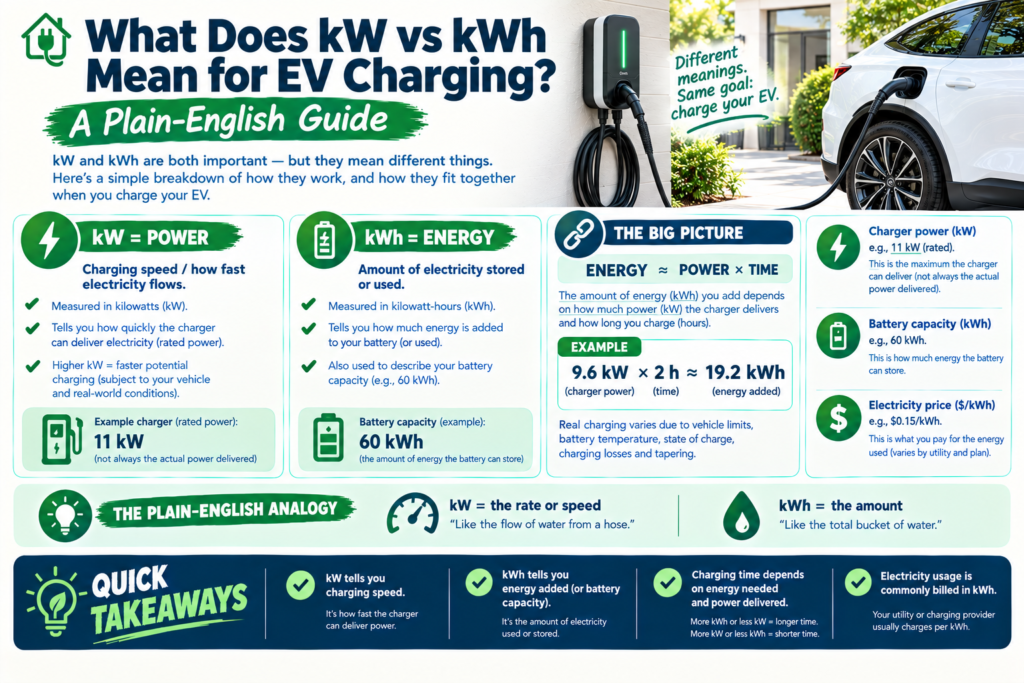
kW (kilowatt) measures power — how fast electricity is flowing at any given moment, like the speed of a faucet. kWh (kilowatt-hour) measures energy — the total amount delivered over time, like the total volume of water that came out of that faucet. Your charger’s kW rating tells you how fast it charges; your battery’s kWh capacity tells you how much energy it can store, and your electric bill charges you based on kWh used, not kW.
The Faucet Analogy
Think of charging your EV like filling a bathtub:
- kW is the flow rate — how many gallons per minute are coming out of the faucet. A wider-open faucet (higher kW) fills the tub faster.
- kWh is the total amount of water delivered — if you run a faucet at a certain flow rate for a certain amount of time, the total volume is flow rate × time. Similarly, kWh = kW × hours.
A 7 kW home charger (a typical 32A/240V Level 2 charger) delivers roughly 7 kWh of energy for every hour it charges. Run it for 5 hours, and you’ve delivered about 35 kWh to your battery.
What kW Tells You About Your Charger
Your charger’s kW rating (sometimes shown as amps × volts instead) tells you its charging speed. To calculate it yourself:
kW = Volts × Amps ÷ 1,000
For example, a 240V circuit at 32 amps: 240 × 32 ÷ 1,000 = 7.68 kW
A higher kW charger delivers energy faster, which is why our guide on how many amps you need for a home EV charger focuses on amperage — since amperage (at a fixed 240V) is what actually determines your kW charging speed at home.
What kWh Tells You About Your Battery and Your Bill
Your EV’s battery capacity is measured in kWh — a “75 kWh battery” can store 75 kilowatt-hours of energy, similar to how a gas tank’s capacity is measured in gallons. This number determines your car’s range: a larger kWh battery generally (though not always, depending on efficiency) means more driving range per full charge.
Your electricity bill also charges you per kWh used, not per kW — meaning it doesn’t directly matter how fast you charged, only how much total energy you drew. Charging fast at 48A or slowly at 16A to fill the same battery to the same level costs roughly the same amount in electricity (aside from minor efficiency differences), since you’re paying for the total kWh delivered either way.
Putting It Together: A Real Charging Example
Let’s say you have a 60 kWh battery at 20% charge (12 kWh remaining used, 48 kWh needed to reach full) and a 7.68 kW home charger (32A at 240V):
Charging time = kWh needed ÷ kW = 48 ÷ 7.68 ≈ 6.25 hours
This is the same calculation covered in more detail in our guide on how long it takes to charge an EV at home — kW and kWh are the two numbers that formula is actually built from.
Why This Distinction Actually Matters for Buying Decisions
Understanding the difference helps you avoid two common buying mistakes:
- Confusing charger speed with battery size. A bigger battery (higher kWh capacity) doesn’t charge faster on its own — charging speed depends on your charger’s kW output and your vehicle’s onboard charger limit, not battery size.
- Assuming a faster charger reduces your electricity costs. It doesn’t — a faster charger (higher kW) gets you to a full battery sooner, but the total kWh used, and therefore the total cost, is essentially the same regardless of charging speed, aside from very minor efficiency variations.
A Note on kWh and Your Electricity Rate
Since your utility bills you per kWh, this is also the number that matters for calculating your actual home charging cost — multiply your local electricity rate (dollars per kWh) by the kWh your charging session used to estimate cost. This is a more useful calculation for budgeting than thinking in terms of kW, which only tells you speed, not total cost.
Worked Example: kW and kWh in One Charging Session
kW is the rate (like gallons per minute at a pump); kWh is the amount (like gallons). Energy (kWh) = power (kW) × hours. One overnight session, step by step:
| Step | Calculation | Result |
|---|---|---|
| Charger power | 32 A × 240 V ÷ 1,000 | 7.68 kW |
| Energy from the wall in 5 hours | 7.68 kW × 5 h | 38.4 kWh |
| Energy into the battery (~90% efficient) | 38.4 × 0.90 | 34.6 kWh |
| Range added | 34.6 kWh × 3.5 mi/kWh | ≈121 miles |
| Cost at 18¢/kWh | 38.4 kWh × $0.18 | $6.91 |
Your utility bills you for the kWh drawn from the wall (38.4 here), not what ends up in the battery — that’s why charging losses matter when estimating cost.
Figures in this example are illustrative and rounded; your rates, vehicle and installation will differ.
Sources and Further Reading
- U.S. DOE Alternative Fuels Data Center — Charging Plug-In Electric Vehicles at Home
- U.S. EIA — Short-Term Energy Outlook: Electricity (residential prices)
Last reviewed: October 2026.
Key Takeaways
- kW measures power (speed of energy flow); kWh measures energy (total amount delivered over time) — kWh = kW × hours.
- Your charger’s kW rating determines charging speed; your battery’s kWh capacity determines total range and how much energy a full charge requires.
- Your electricity bill is based on kWh used, not kW, meaning charging speed doesn’t directly affect your total cost for the same amount of charging.
- Understanding this distinction helps you correctly interpret charger specs and calculate realistic charging times and costs.
Frequently Asked Questions
Does charging faster (higher kW) waste more electricity? No — the total kWh delivered to reach a given battery level is essentially the same regardless of charging speed, so faster charging doesn’t meaningfully waste electricity in typical home charging scenarios.
Why do public fast chargers advertise much higher kW numbers than home chargers? DC fast chargers operate at far higher power levels (often 50-350 kW) than home Level 2 charging (typically 3.3-11.5 kW), which is why they can add significant range in minutes rather than hours — but they use different technology and aren’t available for home installation.
How do I convert my charger’s amp rating to kW? Multiply your circuit’s voltage (240V for home Level 2 charging) by the amperage, then divide by 1,000 — for example, a 40A charger: 240 × 40 ÷ 1,000 = 9.6 kW.