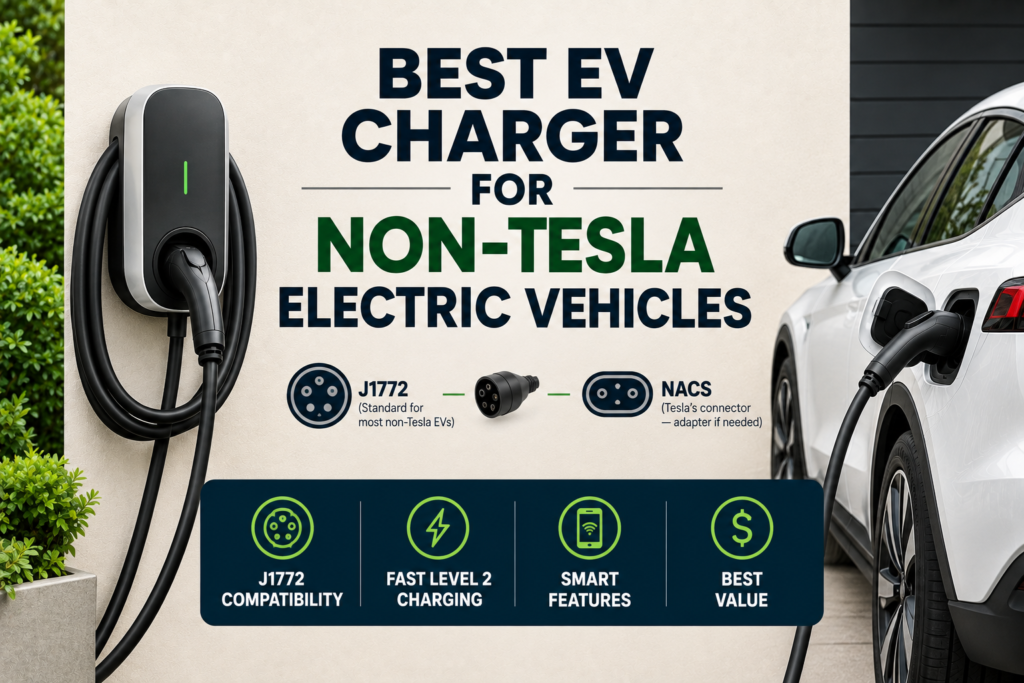
With dozens of Level 2 chargers on the market, picking one usually comes down to matching a specific model to your specific situation — your vehicle, your budget, and what features actually matter to you. Rather than a single “best” pick, here’s a breakdown by use case, based on the amperage, features, price, and installation flexibility of each model.
Quick Picks
- Best overall: ChargePoint Home Flex
- Best budget: Grizzl-E Classic
- Best for Tesla owners: Tesla Wall Connector
- Best for non-Tesla EVs: Emporia EV Charger
- Best smart features: Wallbox Pulsar Plus
- Best for multi-EV households: Wallbox Pulsar Plus (power sharing)
- Best rugged/outdoor charger: Autel MaxiCharger
- Best compact design: Wallbox Pulsar Plus
Best Overall: ChargePoint Home Flex
Price: $500 – $650 | Max amperage: 50A (adjustable) | Installation:Hardwired or plug-in
ChargePoint Home Flex earns the top overall spot because it doesn’t force a trade-off: it supports the widest adjustable amperage range in this list, works with virtually any EV via the universal J1772 connector, and offers both hardwired and plug-in installation. It also ties into the ChargePoint public charging network, a genuine bonus if you already use public ChargePoint stations. The only real downside is price — it’s not the cheapest option here, but it’s hard to beat on flexibility alone. See our full ChargePoint Home Flex vs Tesla Wall Connector comparison for more detail.
Best Budget: Grizzl-E Classic
Price: $270 – $400 | Max amperage: Up to 40A | Installation: Hardwired or plug-in
If minimizing cost is the priority, the Grizzl-E Classic delivers reliable Level 2 charging in a notably rugged, weatherproof housing — without paying for app connectivity you might not use. It’s a particular favorite in cold-weather climates, where its build quality has a strong track record. The trade-off is no WiFi or app on the base model, so you lose scheduling and energy monitoring. Our Emporia vs Grizzl-E comparison breaks down exactly what you give up at this price point.
Best for Tesla Owners: Tesla Wall Connector
Price: $400 – $450 | Max amperage: 48A | Installation: Hardwired only
For a Tesla-only household, this is difficult to beat on value: solid build quality, full integration with the Tesla app, and typically a lower price than universal alternatives with comparable specs. The catch is that it’s hardwired-only, and using it with a non-Tesla EV requires an adapter with more limited app support — see our dedicated guide on the Tesla Wall Connector for non-Tesla EVs if that applies to you.
Best for Non-Tesla EVs: Emporia EV Charger
Price: $350 – $450 | Max amperage: Up to 48A | Installation: Hardwired or plug-in
Emporia stands out for pairing genuinely useful smart features — real-time energy tracking, cost-per-charge estimates, and off-peak scheduling — with a price that undercuts many premium competitors. It uses the universal J1772 connector, so compatibility across non-Tesla EV brands is straightforward. It’s an especially strong pick if you also use or plan to use Emporia’s home energy monitoring products.
Best Smart Features: Wallbox Pulsar Plus
Price: $550 – $700 | Max amperage: 48A | Installation: Hardwired or plug-in
Wallbox’s app is consistently praised as one of the most polished in this category, and the Pulsar Plus backs it up with one of the smallest physical footprints on the market — useful if garage space is tight. It commands a premium price, but for buyers who want the most refined day-to-day smart-charging experience, it’s worth the extra cost.
Best for Multi-EV Households: Wallbox Pulsar Plus (Power Sharing)
Price: $550 – $700 (per unit) | Max amperage: 48A | Installation:Hardwired or plug-in
If your household has, or will have, two EVs charging on a shared circuit, Wallbox’s power-sharing feature is a genuinely unique advantage in this list: two compatible units automatically balance available power between them, which can help you avoid a costly panel upgrade that a two-charger setup might otherwise require. See our full Autel vs Wallbox comparison for how this stacks up against a higher-amperage single-charger alternative.
Best Rugged/Outdoor Charger: Autel MaxiCharger
Price: $450 – $600 | Max amperage: 50A | Installation: Hardwired or plug-in
Autel’s MaxiCharger combines the highest amperage in this list with a weatherproof housing built specifically for harsher outdoor conditions, at a price that undercuts several competitors with similar specs. It’s a strong pick if your installation is fully exposed outdoors, or if you want the extra amperage headroom for a larger EV or future vehicle.
How to Choose Between These Picks
Rather than starting from the “best overall” pick, work through these three questions first:
- What amperage do you actually need? Check our guide on how many amps you need for a home EV charger — buying more amperage than your vehicle or panel can use adds cost without adding real-world speed.
- Do you need Tesla compatibility, non-Tesla compatibility, or both? This alone can eliminate several options quickly.
- Do you want smart features, or would you rather save money with a basic charger? Our WiFi-enabled vs. basic chargers comparison walks through when the smart-charger premium is actually worth paying.
Worked Example: Narrowing the List by Amps and Budget
Start with the circuit, not the brand. Each charger setting needs a breaker of at least amps ÷ 0.8, and the circuit decides how fast any charger on this list can go (240 V, 3.5 miles per kWh):
| Your available circuit | Max charger setting | Power | Range per hour | Who it suits |
|---|---|---|---|---|
| 40 A breaker | 32 A | 7.68 kW | ≈27 miles | Most commuters |
| 50 A breaker (incl. NEMA 14-50) | 40 A | 9.60 kW | ≈34 miles | Long commutes, larger batteries |
| 60 A breaker, hardwired | 48 A | 11.52 kW | ≈40 miles | Trucks, two-EV homes (if the car accepts 11.5 kW) |
Example: a driver averaging 40 miles a day needs about 12.7 kWh from the wall (40 ÷ 3.5 ÷ 0.90). On a 40 A circuit that takes 12.7 ÷ 7.68 ≈ 1.7 hours a night, so paying extra for a 48 A model buys almost nothing — spend the difference on certification, warranty or features you’ll use.
Figures in this example are illustrative and rounded; your rates, vehicle and installation will differ.
Sources and Further Reading
- ENERGY STAR — Certified Electric Vehicle Chargers
- U.S. DOE Alternative Fuels Data Center — Charging Plug-In Electric Vehicles at Home
- NFPA 70, National Electrical Code (Article 625 covers EV charging equipment)
Last reviewed: October 2026.
Key Takeaways
- There’s no single “best” charger — the right pick depends on your vehicle brand, amperage needs, budget, and whether smart features matter to you.
- ChargePoint Home Flex is the strongest all-around pick for most non-Tesla households; Tesla Wall Connector is the value pick for Tesla-only homes.
- Grizzl-E offers the best value for buyers who don’t need app connectivity; Wallbox and Emporia lead on smart features.
- Multi-EV households should specifically consider Wallbox’s power-sharing capability before assuming a panel upgrade is necessary.