Introduction
2026 is shaping up to be a pivotal year for electric vehicle (EV) charging hardware. As EV adoption accelerates globally, charger manufacturers are responding with a new generation of models that address faster charging speeds, increased reliability, smarter grid integration, and improved user experience. This post summarizes the major trends, the types of new charger models expected to launch in 2026, the technological improvements they bring, and practical considerations for fleet operators, businesses, and homeowners.
Market Context: Why 2026 Matters
Several forces converge in 2026 to drive product launches and upgrades in the EV charging space:
- Higher EV volumes: Broader EV model availability and lower total cost of ownership increase demand for both public and private charging infrastructure.
- Grid modernization: Utilities and regulators push for smarter chargers that support demand management, time-of-use pricing, and grid services like load balancing and vehicle-to-grid (V2G).
- Standards harmonization: Connector convergence (e.g., wider adoption of CCS and increasing support for NACS adapters) and interoperability expectations push manufacturers to offer flexible hardware.
- Technological maturity: Advances in power electronics, cooling systems, and software enable smaller, more powerful, and more connected chargers.
New Charger Categories and Notable Model Types to Watch
Rather than listing every new SKU, it’s useful to group incoming 2026 models by the problems they solve and the features they emphasize.
Ultra-fast DC Fast Chargers (150–600+ kW)
Ultra-fast chargers continue to be the headline grabbers. In 2026 expect new models that push peak power higher, improve thermal management, and adapt to 800V+ vehicle architectures.
- Key features: 150–600+ kW power ranges, liquid or advanced air cooling, modular designs for clustering, high-voltage compatibility (up to 1000 V).
- Typical buyers: Highway operators, fleet depots, highway service plazas, and commercial sites seeking short dwell-time charging.
Smart Multi-Port Chargers and Scalable Stations
Scalability is a major theme: one power cabinet feeding multiple dispensers, dynamic power sharing, and smarter queuing logic. These models let site owners add dispensers without major electrical upgrades.
- Key features: Dynamic load allocation, integrated billing and back-office connectivity, and modular expansion.
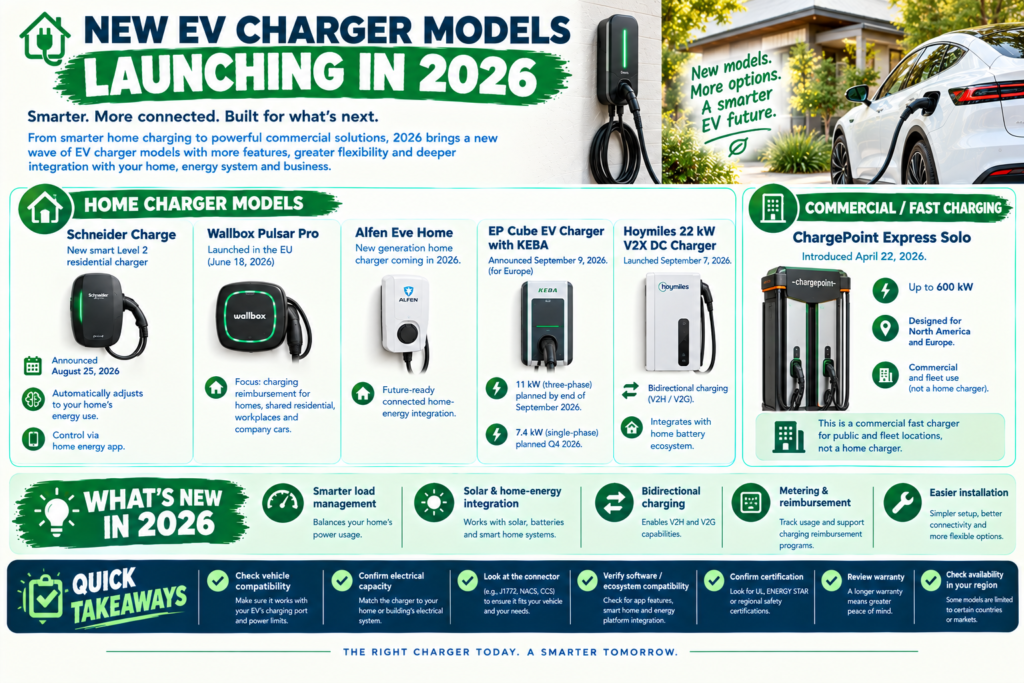
Residential and Workplace AC Chargers (7–22 kW)
Expect new residential chargers that are more compact, elegantly designed, and increasingly intelligent. Important advances include integrated solar PV integration, simplified installation workflows, and bidirectional capability for V2G at home.
- Key features: Wi-Fi/ethernet connectivity, app-based scheduling, smart energy management, and optional V2H/V2G support.
Bidirectional and V2G-Ready Units
Vehicle-to-grid and vehicle-to-home functionality moves from pilot projects toward commercial availability. New 2026 models focus on compliance with emerging grid interconnection rules and simplified user controls.
- Key features: ISO and grid-compliant V2G protocols, certified safety interlocks, and clear revenue/compensation dashboards for grid services.
Wireless and Inductive Chargers
Wireless charging remains a smaller but advancing niche. New 2026 inductive chargers aim for better alignment, higher efficiency, and simpler installation for fleet applications where docking is frequent.
- Key features: Improved alignment tolerance, higher kW ratings (targeting ~11–22 kW for stationary units), and integrated safety systems.
Technical Innovations Driving 2026 Models
Several technical advances distinguish the 2026 generation of chargers:
- Higher power density: Advances in silicon carbide (SiC) and GaN semiconductors enable smaller power modules with lower losses and higher efficiency.
- Modular architectures: Power cabinets with swappable modules reduce downtime and let operators scale power capacity as demand grows.
- Advanced cooling: Liquid cooling and improved airflow management permit sustained high-power charging without throttling.
- Edge computing & analytics: Onboard intelligence reduces latency for user interactions and enables predictive maintenance via telemetry.
- Interoperability: Native support for multiple protocols, better backend APIs, and compliance with open network standards.
Considerations for Buyers and Installers
When evaluating new 2026 charger models, consider the following:
- Site electricity capacity: High-power chargers require significant grid connections—assess upgrade costs and timelines early.
- Scalability: Choose modular systems if you expect charging demand to grow rapidly.
- Software ecosystem: Look for chargers with flexible back-office integrations, real-time monitoring, and OTA updates.
- Standards & connectors: Ensure compatibility with CCS, NACS (via adapters where necessary), and any local mandates.
- Total cost of ownership: Factor in maintenance contracts, network fees, and expected energy costs—not just unit price.
How to Pick the Right 2026 Model for Your Use Case
Match charger capabilities to your use case:
- Home charging: Prioritize reliability, integration with home energy systems, and simple app controls. V2G can be attractive where tariffs or incentives exist.
- Workplace charging: Balance cost and power—22 kW AC or lower-power DC solutions often suffice, with smart scheduling to avoid peak demand charges.
- Public & highway charging: Invest in higher-power DC fast chargers with reliable uptime, strong service agreements, and payment interoperability.
- Fleet depots: Opt for mixed-power installations—ultra-fast chargers for quick turnarounds and slower high-power DC or AC options for overnight charging; consider depot energy management and on-site storage.
Worked Example: Upgrade Now or Wait?
New models often advertise higher power, but your car’s onboard charger and your circuit set the real ceiling. Adding 40 kWh from the wall at 240 V:
| Charger you have | New model you’re eyeing | Your car accepts | Time now | Time with new model |
|---|---|---|---|---|
| 32 A (7.68 kW) | 48 A (11.52 kW) | 7.2 kW | 5.6 h | 5.6 h — no gain |
| 32 A (7.68 kW) | 48 A (11.52 kW) | 11.5 kW | 5.2 h | 3.5 h — needs a 60 A circuit |
| Level 1 (1.44 kW) | Any Level 2, 32 A | 7.2 kW+ | 27.8 h | 5.2 h — big gain |
If you already have a working, certified Level 2 charger and your car can’t accept more power, a new launch rarely changes your daily experience. Waiting makes the most sense when you need a specific new feature, such as a NACS connector or bidirectional charging support for a compatible vehicle.
Figures in this example are illustrative and rounded; your vehicle and installation will differ.
Sources and Further Reading
- ENERGY STAR — Certified Electric Vehicle Chargers
- U.S. DOE Alternative Fuels Data Center — Charging Plug-In Electric Vehicles at Home
Last reviewed: October 2026.
Conclusion
2026 promises a strong wave of new EV charger models that emphasize power, intelligence, and flexibility. Whether you operate a fleet, manage public charging, or plan a residential install, the latest generation of chargers provides more options than ever—faster charging, better grid interaction, and smarter software. When selecting a model, focus on long-term site needs, interoperability, and the total cost of ownership. By aligning your purchase with emerging standards and operational requirements, you’ll be ready for the next stage of EV adoption.
Next steps: Monitor manufacturer announcements and pilot results, request site-specific load studies, and evaluate financing or incentive programs that can reduce upfront costs.