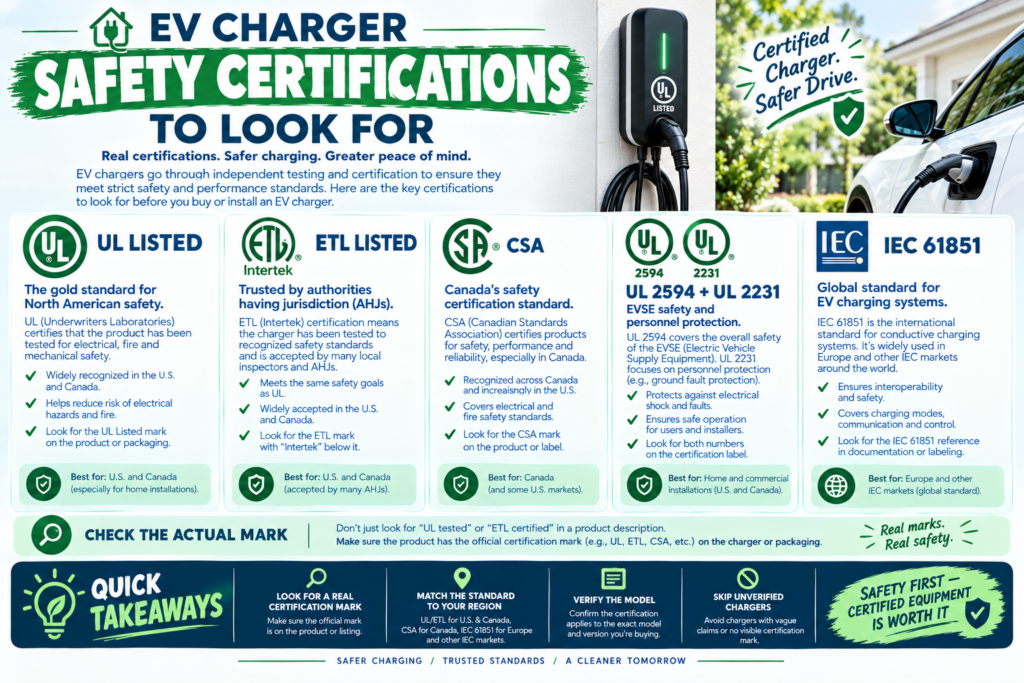
With dozens of charger brands and an increasing number of lesser-known models available online, safety certification is the one spec that shouldn’t be treated as optional or negotiable. Here’s what these certifications actually mean, why they matter, and how to confirm a charger has them before you buy.
Quick Answer
Look for UL Listed or ETL Certified on any home EV charger before purchasing — these indicate the product has been independently tested against recognized U.S. safety standards for electrical equipment. Additionally, ENERGY STAR certification, while not a safety certification itself, is required or preferred by several state and utility rebate programs, so it’s worth checking if you plan to apply for an incentive.
UL Listing: The Primary Safety Certification to Check
UL (Underwriters Laboratories) is one of the most widely recognized independent product safety testing organizations in the U.S. A charger that is “UL Listed” has been tested against specific safety standards covering electrical shock, fire, and other hazards, and the manufacturer is subject to ongoing factory inspections to confirm continued compliance.
For EV chargers specifically, look for compliance with UL 2594 (Standard for Electric Vehicle Supply Equipment), the primary safety standard covering this category of product. You’ll typically find this information on the product packaging, in the manual, or on the manufacturer’s specification page.
ETL Certification: An Equivalent Alternative
ETL Certified (from Intertek) is a widely recognized alternative to UL listing, indicating the product has been tested against the same recognized safety standards by a different accredited testing laboratory. ETL and UL certifications carry equivalent regulatory weight in the U.S. — a charger with either mark has met the same underlying safety requirements, just verified by a different certification body.
Why This Matters More Than It Might Seem
EV chargers handle continuous, high-amperage current (commonly 30-60 amps) for extended periods — a meaningfully higher and more sustained electrical load than most household electronics. Proper certification testing specifically evaluates:
- Insulation and internal wiring safety under continuous load
- Overheating and thermal protection
- Water and dust resistance (for outdoor-rated models)
- Ground fault and short-circuit protection
- Mechanical durability of the connector and housing
An uncertified or unknown-brand charger sold cheaply online may look similar on the outside, but skipping this testing process means there’s no independent verification that it handles these risks safely under real-world, continuous use.
ENERGY STAR Certification: Different From Safety, But Often Required
ENERGY STAR certification indicates a product meets specific energy efficiency criteria — it’s not a safety certification, but it has become directly relevant to EV charger buyers because:
- Several state and utility rebate programs specifically require ENERGY STAR certification as an eligibility condition (see our guide on SWEPCO’s Texas rebate program, for example, which requires this specifically)
- It generally indicates a well-engineered, efficient product from a manufacturer investing in third-party verification, even though its primary purpose is efficiency rather than safety
If you’re planning to apply for any rebate program, check that program’s specific equipment requirements before purchasing, since ENERGY STAR certification (or a specific approved-product list) is a common condition across many state and utility incentive programs — see our EV charger incentive guides by state for program-specific requirements.
How to Verify a Charger’s Certifications
- Check the product listing or manual for explicit mention of UL Listed or ETL Certified status, along with the specific standard (UL 2594) referenced.
- Look for the physical certification mark on the product itself, typically printed or embossed on the housing or included in product photos.
- Search the certifying body’s database — both UL and Intertek (ETL) maintain searchable online databases where you can verify a specific product or manufacturer’s certification status directly, which is worth doing for lesser-known brands.
- Check for ENERGY STAR listing on the ENERGY STAR product database if you’re planning to apply for a rebate program that requires it.
Red Flags to Watch For
- No mention of any safety certification anywhere in the product listing, manual, or manufacturer website
- Extremely low pricing compared to comparable certified chargers, which can sometimes (though not always) indicate corners cut on testing and certification
- Unfamiliar brand names with no verifiable certification database listing, particularly for chargers sold through third-party marketplace listings rather than the manufacturer’s own site or major retailers
- Vague claims like “meets safety standards” without specifying which certification or standard is actually being referenced
Does Certification Guarantee a Good Product?
Certification confirms a baseline of safety testing — it doesn’t guarantee the best charging speed, smart features, build quality, or customer support compared to competitors. All of the specific chargers covered in our comparison guides (ChargePoint, Tesla, Emporia, Grizzl-E, JuiceBox, Autel, and Wallbox) carry recognized safety certification, so among established brands, certification is a baseline expectation rather than a differentiator — the real decision points are the ones covered in our full guide to the best home EV chargers of 2026.
Key Takeaways
- Look for UL Listed or ETL Certified status, specifically referencing UL 2594, before purchasing any home EV charger.
- These certifications indicate independent, ongoing safety testing for electrical shock, fire, and overheating risks under continuous high-amperage use.
- ENERGY STAR certification isn’t a safety mark, but it’s often required for state and utility rebate eligibility.
- Established, well-known charger brands typically carry proper certification as standard — the biggest risk is with unfamiliar, extremely low-cost models sold through third-party marketplace listings.
Frequently Asked Questions
Is a charger without UL or ETL certification illegal to sell in the U.S.? Certification requirements can vary by state and local code, but many jurisdictions require certified equipment for permitted electrical installations regardless of general retail sale rules — an uncertified charger may also simply fail inspection during your permit process, covered in our guide on whether you need a permit to install an EV charger.
Can I check certification status before buying online? Yes — both UL’s and Intertek’s (ETL) certification databases are searchable online by product or manufacturer name, which is worth doing for any brand you’re not already familiar with.
Does certification affect my insurance if something goes wrong? It can — using uncertified electrical equipment could complicate an insurance claim related to fire or electrical damage, similar to the way unpermitted electrical work can create insurance issues, covered in our permit guide.