
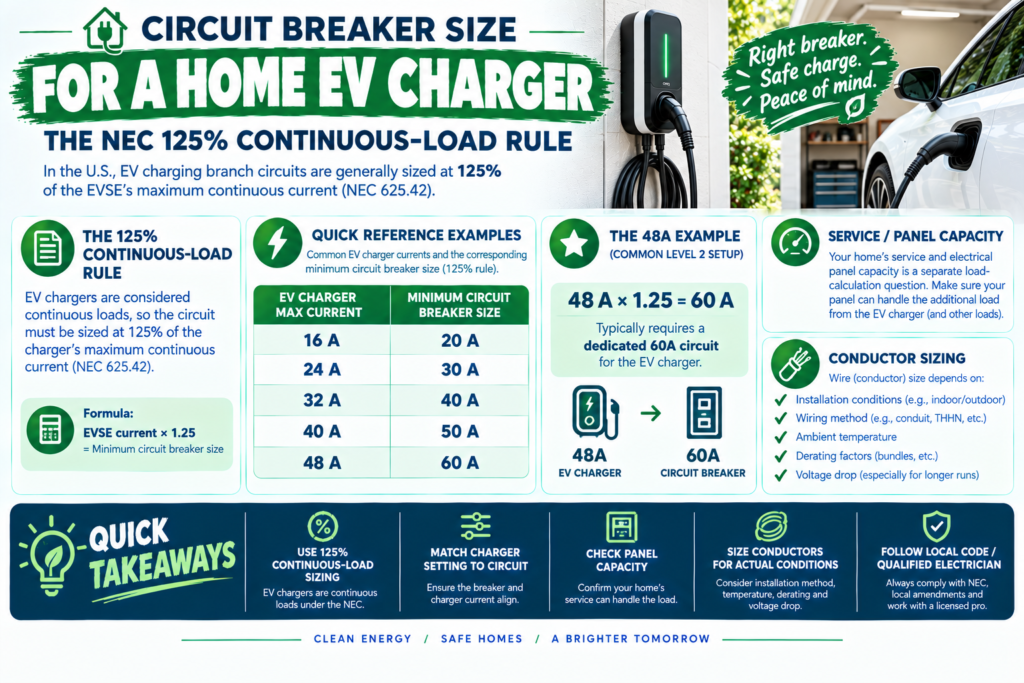
If you’ve seen a “40-amp charger” paired with a “50-amp breaker” and wondered why the numbers don’t match, this is one of the most misunderstood parts of EV charger installation. Here’s exactly how breaker sizing works, and a quick reference so you don’t have to do the math yourself every time.
Quick Answer
Your circuit breaker must be sized at 125% of your EV charger’s rated amperage, per the National Electrical Code’s continuous load rule (NEC 625). This means a 40-amp charger requires a 50-amp breaker, and a 48-amp charger requires a 60-amp breaker. This isn’t optional or a manufacturer preference — it’s a code requirement specifically because EV charging is classified as a continuous load, sustained for three hours or more at a time.
Why the Breaker Is Always Larger Than the Charger
Continuous electrical loads generate more sustained heat in wiring and breakers than loads that cycle on and off, like most household appliances. The National Electrical Code addresses this by requiring continuous loads to be calculated at 80% of a circuit’s rated capacity, which is mathematically the same as saying the circuit must be rated at 125% of the actual continuous load:
Required breaker size = Charger amperage ÷ 0.8
or equivalently:
Required breaker size = Charger amperage × 1.25
This safety margin exists specifically to prevent breakers and wiring from overheating during the long, sustained draw that EV charging involves — very different from, say, a vacuum cleaner or microwave that draws power in short bursts.
Quick Reference Chart
| Charger amperage | Required breaker size |
|---|---|
| 16A | 20A |
| 24A | 30A |
| 32A | 40A |
| 40A | 50A |
| 48A | 60A |
| 50A | 60A (rounded to nearest standard size) |
Breaker sizes are manufactured in standard increments (20, 30, 40, 50, 60A, etc.), so the calculated value is always rounded up to the next standard breaker size available, not sized to an exact non-standard number.
This Also Affects Your Wire Gauge
A larger breaker size means your circuit also needs correspondingly rated wiring — you can’t pair a 60-amp breaker with wire only rated for 40 amps. This is part of why higher-amperage chargers cost more to install: it’s not just a bigger breaker, but thicker, more expensive wire and conduit as well, covered in more detail in our guide on how many amps you need for a home EV charger.
What Happens If the Breaker Is Undersized?
An undersized breaker relative to your charger’s amperage creates a real safety issue:
- Nuisance tripping, where the breaker repeatedly trips during normal charging, which is actually the breaker doing its job correctly by protecting an overloaded circuit
- Overheating risk if a breaker is somehow bypassed or improperly rated for the actual continuous load it’s carrying
- Code violation, which can cause a failed inspection and create the insurance and resale issues covered in our guide on whether you need a permit to install an EV charger
If your charger is tripping a breaker repeatedly, this is a sign of a genuine sizing problem, not something to work around by simply resetting it repeatedly — see our troubleshooting guide on why your EV charger might not be charging correctly for what to check.
Can You Use a Larger Breaker Than Required “Just in Case”?
No — a breaker must match the wire gauge and the charger’s actual rated load, not be oversized as a buffer. An oversized breaker relative to the wiring it protects defeats the breaker’s safety purpose, since it may not trip quickly enough to protect wiring that’s rated for a lower amperage than the breaker allows. This is exactly why breaker size, wire gauge, and charger amperage all need to be calculated together by a licensed electrician, rather than treated as independent choices.
Does This Rule Apply to Adjustable-Amperage Smart Chargers?
Yes — if your charger’s amperage is software-adjustable (common on models like ChargePoint Home Flex or Autel MaxiCharger), the breaker and wiring must be sized for the maximum amperage the unit is capable of, not just the setting you initially configure. This is important if you plan to increase the amperage later, since the electrical infrastructure needs to support that maximum from the start — see our comparison of 40 amp vs 48 amp EV chargers for how this factors into your initial decision.
Key Takeaways
- Circuit breakers for EV chargers must be sized at 125% of the charger’s rated amperage, per NEC’s continuous load rule.
- This means a 40A charger needs a 50A breaker, and a 48A charger needs a 60A breaker — always rounded to the next standard breaker size.
- Wire gauge must be sized to match the breaker, not just the charger’s amperage, which is a real cost factor in higher-amperage installations.
- For adjustable-amperage smart chargers, the breaker must support the charger’s maximum possible setting, not just your initial configuration.
Frequently Asked Questions
Why can’t I just use a smaller breaker to save on installation cost? An undersized breaker relative to your charger’s continuous load creates a genuine fire safety risk and will likely trip repeatedly or fail inspection — this isn’t a place to cut costs.
Does this 125% rule apply to the charger itself, or just the breaker? It specifically applies to circuit sizing (breaker and wire gauge) relative to the continuous load the charger represents — the charger itself is simply rated at its actual maximum output (the 40A or 48A figure), while the circuit protecting it is sized larger per code.
Is this rule unique to EV chargers, or does it apply to other equipment too? The NEC’s continuous load rule applies broadly to any electrical load running continuously for three hours or more, not just EV chargers — but EV charging is one of the most common residential examples homeowners encounter this rule for directly.

